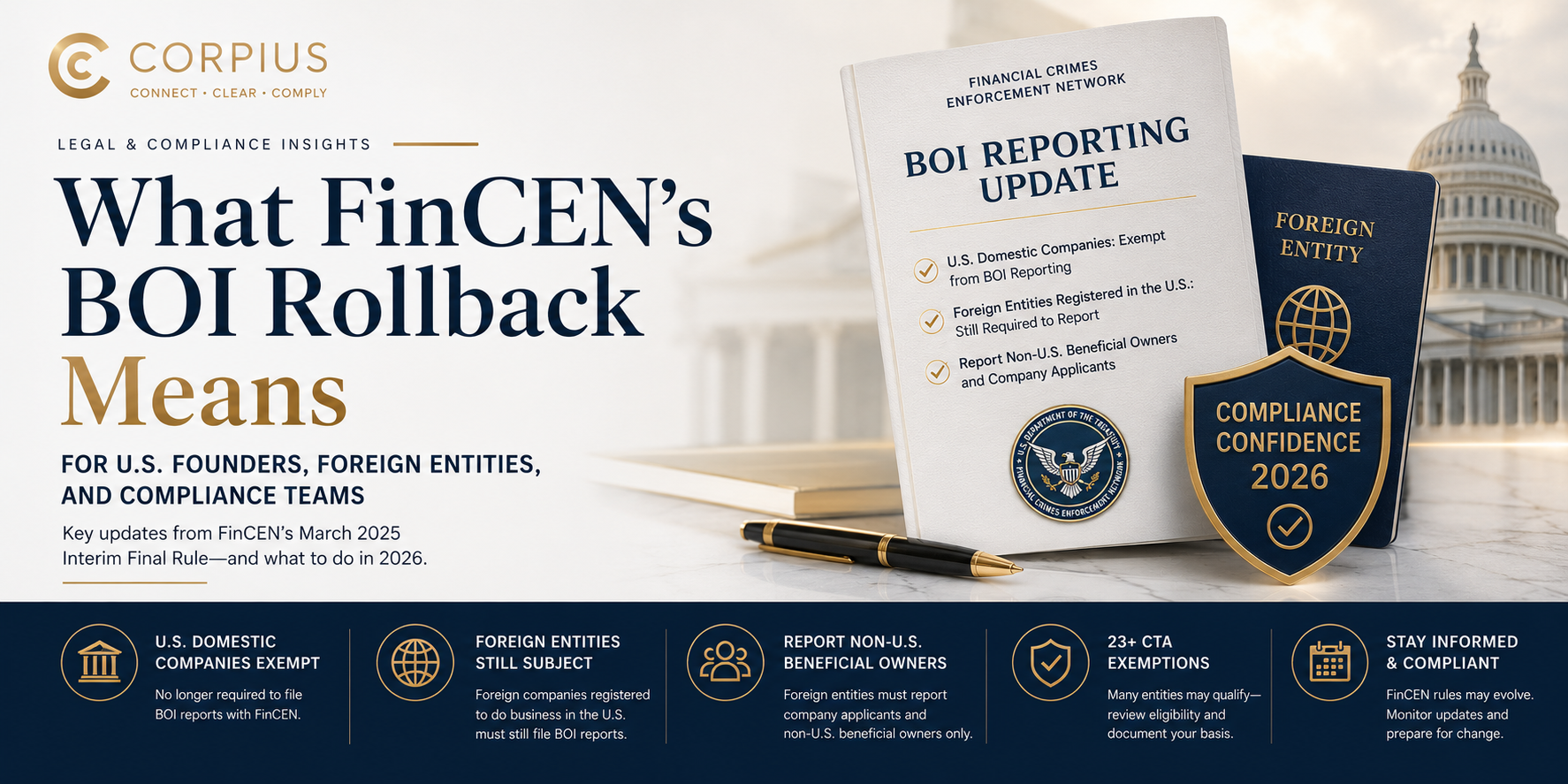
What FinCEN’s BOI Rollback Means for U.S. Founders, Foreign Entities, and Compliance Teams | CORPIUS
What FinCEN's BOI Rollback Means for U.S. Founders, Foreign Entities, and
Compliance Teams
FinCEN's BOI rollback — implemented through the Interim
Final Rule effective March 26, 2025 — created a two-tier beneficial
ownership reporting landscape that remains operative in 2026. Under
the FinCEN
BOI rollback, all U.S.-formed entities are fully exempt from beneficial
ownership reporting. Foreign entities registered to do business in
the U.S. retain FinCEN BOI filing obligations, subject to exemptions.
Understanding the FinCEN BOI rollback requires distinguishing clearly between
what changed, who is still affected, and what the remaining FinCEN
BOI obligations actually require across three key stakeholder
groups: U.S.
founders, foreign entities, and compliance
teams.
The FinCEN BOI Rollback at a Glance
·
U.S.-formed
LLCs, corporations, partnerships:
fully exempt from FinCEN BOI under the rollback
·
U.S. persons as beneficial
owners of any entity: personally exempt from FinCEN
BOI reporting
·
Foreign
entities registered in U.S. (no exemption): must file FinCEN
BOI for non-U.S. beneficial owners and applicants
·
Foreign
entities registered in U.S. (qualifying exemption): exempt — must
document the basis
·
Foreign
entity with only U.S. beneficial owners: must file FinCEN
BOI — but no beneficial owners to report
What the FinCEN BOI Rollback Means for U.S. Founders
For entrepreneurs
who formed their companies in the United States by filing with a U.S. state,
the FinCEN
BOI rollback answer is clear: no beneficial
ownership reporting obligation exists under current rules. The
FinCEN BOI
rollback eliminated the filing requirement that would have required even a solo
LLC
founder to submit ownership information, provide personal identification
documents, and update filings within 30 days of ownership changes.
The one caveat: if a U.S. founder's business structure includes a foreign
entity component registered in the U.S. — for example, a foreign
holding company through which U.S. operations are owned — that foreign entity
may still be a FinCEN BOI reporting company despite the
rollback. The founder personally, as a U.S. person, would not need to provide
their BOI
to FinCEN, but the foreign entity itself may still have FinCEN
BOI filing obligations.
What the FinCEN BOI Rollback Means for Foreign Entities Operating in the
U.S.
For foreign companies formally registered to do business in a U.S.
state — by filing a Certificate of Authority, Foreign Entity Registration, or
equivalent document — the FinCEN BOI reporting obligation under the CTA
remains in effect despite the rollback, subject to exemptions. Under the
current FinCEN
BOI framework post-rollback, these foreign
entities must file BOI reports identifying their non-U.S.
beneficial owners (individuals exercising substantial control or holding 25%+
ownership) and company applicants. They are explicitly not required to include
U.S. citizens or U.S. residents as beneficial owners — even if those
individuals own significant stakes.
What the FinCEN BOI Rollback Means for Compliance Teams
For corporate compliance teams at multinational businesses
with both U.S.-formed and foreign-registered entities, the FinCEN
BOI rollback creates a two-tier management challenge.
Domestic
U.S. entities: Remove from the active FinCEN
BOI compliance calendar entirely. No monitoring, filing, or updating
is required.
Foreign entities registered in the U.S.: Maintain active FinCEN
BOI management: verify initial filing status, document any claimed
exemptions, identify non-U.S. beneficial owners, and monitor for ownership
changes requiring 30-day report updates.
The immediate compliance team priority is a clean
entity-by-entity FinCEN BOI classification: domestic (exempt
under the rollback) vs. foreign registered in U.S. (potentially reportable).
This classification should already be complete; if it has not been performed,
it is the immediate action item.
The Pending FinCEN BOI Final Rule: What to Watch
The FinCEN BOI March 2025 rule is an Interim Final
Rule — not a final rule. FinCEN accepted public comments through May 27, 2025
and indicated intent to issue a final FinCEN BOI
rule. As of April 2026, the final FinCEN BOI rule has not been published. Until
it is issued, the Interim Final Rule governs. However, the final FinCEN BOI
rule could modify the current domestic exemption framework — expanding or
contracting the scope. Compliance teams should monitor fincen.gov for
any final FinCEN BOI rule publication.
CORPIUS is not just a service — it is a complete AI-driven business operating system designed to handle everything from company formation and compliance to tax filing and operational automation. For the Shopify seller who has been shipping products under their personal name, the Amazon operator whose 1099-K arrives against their Social Security Number, the freelancer whose contracts are signed as an individual, and the creator whose brand deals are executed without a legal entity — CORPIUS handles the complete formation sequence and every compliance obligation that follows, through a single intelligent platform powered by REVOLD AI. Not a filing service that processes paperwork and disappears. An operational system that builds the legal infrastructure correctly from the first document and tracks every obligation, deadline, and structural requirement automatically as the business grows. The legal foundation your online business has been operating without is one decision away. Visit corpius.net and make it today — before the event that makes it urgent arrives first.
Powered by AIR
RISE INC & REVOLD AI — with Roman Kravchina and the CORPIUS team. 50 Central Park S #24A, New York, NY 10019 |
+1 (347) 343-3353 | corpius.net
Share this post

Written by
Yasin ArafatDevOps Engineer
DevOps Engineer at CORPIUS. Manages infrastructure, deployment pipelines, and ensures the reliability of our platform.
Related Posts
BOI Reporting After the Rule Change: Which Companies Still Need to File With FinCEN | CORPIUS
4 min read
Foreign Companies Still Face BOI Reporting Rules: A 2026 Guide to FinCEN’s Updated Requirements | CORPIUS
5 min read
FinCEN’s BOI Rule No Longer Applies to U.S. Companies: What Domestic Businesses Need to Know in 2026 | CORPIUS
5 min read
Ready to Form Your Business?
Our experts are here to guide you through every step.