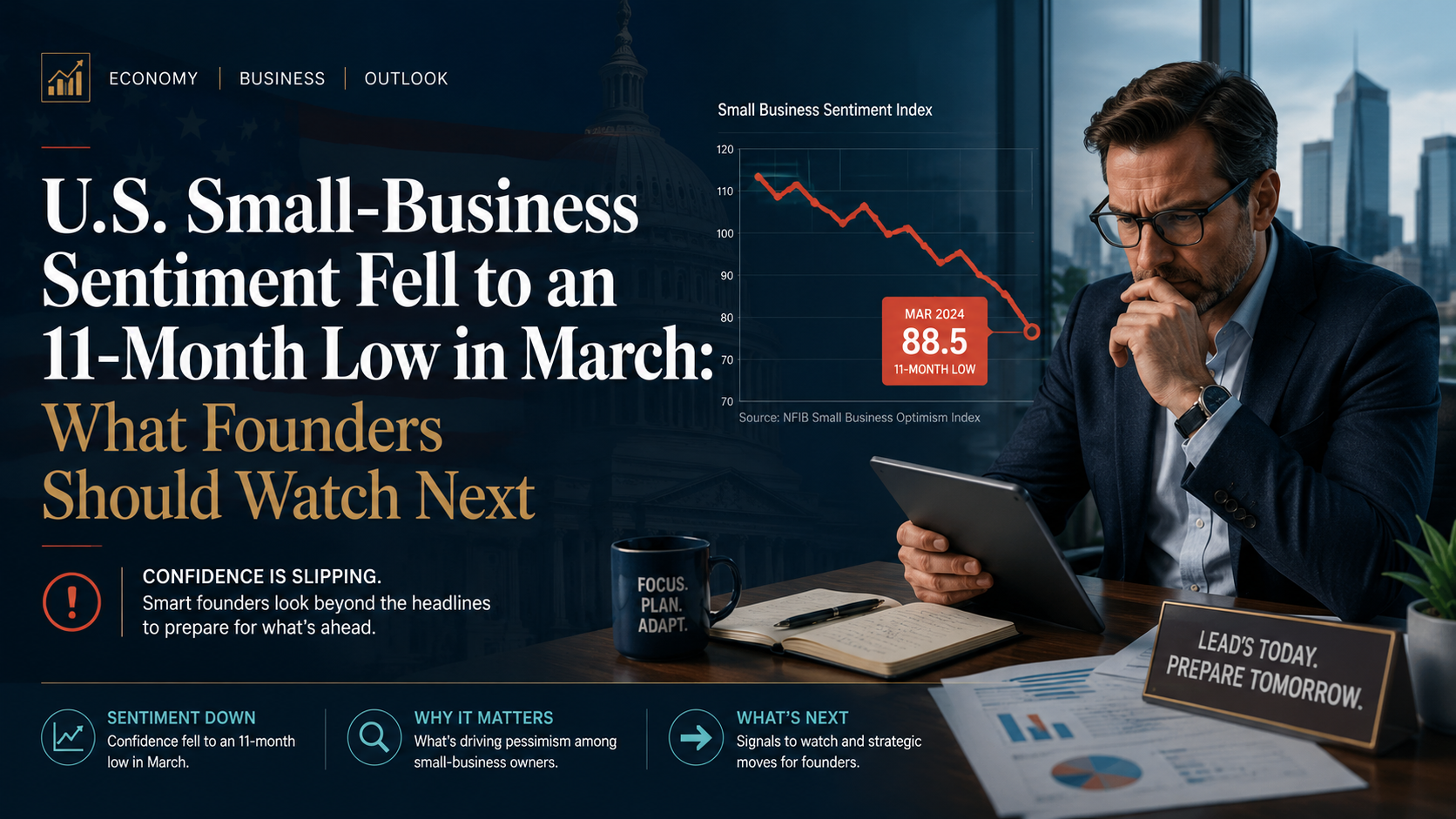
U.S. Small-Business Sentiment Fell to an 11-Month Low in March: What Founders Should Watch Next | CORPIUS
U.S. Small-Business Sentiment Fell
to an 11-Month Low in March: What Founders Should Watch Next
U.S. small-business
sentiment dropped to an 11-month low in March 2026. The National Federation of
Independent Business released its NFIB Small Business Optimism Index for March
on April 14, 2026, showing a 3.0-point decline to 95.8 — the lowest NFIB
small-business sentiment reading since April 2025 and the index's first drop
below its 52-year historical average of 98.0 in nearly a year. NFIB Chief Economist
Bill Dunkelberg cited a spike in oil prices as the primary driver of the
small-business sentiment decline: tax cut benefits from the Working Families Tax Cut Act were offset by rising input costs that owners had to absorb
or pass to customers.
Key Takeaways: NFIB Small Business
Optimism Index March 2026
·
NFIB Small Business Optimism Index March 2026:
95.8 — down 3.0 points from February
·
Small-business
sentiment at its lowest level since April 2025 — the 11-month low
referenced in reporting
·
NFIB index fell below its 52-year historical
average of 98.0 for the first time since April 2025
·
Primary driver of small-business
sentiment decline: positive profit trends fell 11 points to a net negative
25%
·
Second driver: expectations for
better business conditions fell 7 points to 11% — third consecutive monthly
decline — lowest since October 2024
·
NFIB Uncertainty Index: rose 4 points to 92,
well above historical average of 68
·
Top concerns: taxes (19%,
unchanged), labor quality (15%), inflation
(14%)
·
Hiring plans: 12% plan new
hires in next three months — near historical average of 11%
·
Capital outlay plans: 16% plan
capital outlays in next six months
·
Cause cited: dramatic spike in oil prices
offsetting Working Families Tax Cut Act benefits
What Drove the Small-Business
Sentiment Decline in March
NFIB
Chief Economist Bill Dunkelberg's March small-business
sentiment statement: "The 20% Small Business Deduction and other
supportive small business tax provisions in the Working Families Tax Cut Act have had many
positives for small business owners. However, the dramatic
spike in oil
prices has spooked consumers and owners alike. Small
business owners are having to absorb those higher input costs and pass them along to
their customers."
The 11-point drop in positive profit trends — to a net negative 25% — was
the single largest contributor to the NFIB small-business sentiment decline. A net
negative reading means more owners reported declining profit trends than improving ones;
at negative 25%, the gap is substantial. For small
businesses in transportation, manufacturing,
retail,
and food
service, rising energy costs translate directly into higher operating expenses that are difficult to absorb
without compressing margins or raising prices.
The Third Consecutive Monthly
Decline in Small-Business Sentiment for Business Conditions
The 7-point fall in owners expecting better business conditions —
to a seasonally adjusted 11%, the lowest since October 2024 — marks the third
straight monthly decline in this NFIB small-business sentiment component. Sequential
deterioration is more significant than any single month's reading because it
indicates a directional shift in owner outlook rather than a one-month anomaly.
The NFIB
Uncertainty Index rising to 92 — well above its 68 historical
average — reinforces this directional reading: higher uncertainty reduces
willingness to commit to capital expenditures, hiring, or inventory
buildup.
The Partial Offset: Tax Provisions
Remain Positive
The Working Families Tax Cut Act's provisions —
particularly the 20% Small Business Deduction for pass-through income — remain a positive factor
for many small
business owners even amid the small-business sentiment decline. The
deduction benefits sole proprietors, partnerships,
S
corporation shareholders, and other pass-through entity owners. The
March data suggests this tax benefit was insufficient to offset the psychological
and financial impact of energy cost spikes. Small-business sentiment indices often respond
more immediately to variable input cost changes (like energy) than to annual tax liability calculations. If energy
prices stabilize, the Working Families Tax Cut benefits may re-emerge as the
dominant small-business sentiment driver.
What to Watch Next for
Small-Business Sentiment
Oil prices: The single most cited external driver of the small-business
sentiment decline. Any sustained reduction would likely be reflected
positively in subsequent NFIB readings.
Hiring intentions: At 12% planning new hires — near historical
averages — the labor market component of small-business sentiment has not deteriorated
as sharply as profit and conditions components.
The next NFIB
release: April 2026 survey results are typically released in
mid-May. Given the sequential deterioration through March, the April reading
will indicate whether the small-business sentiment trend is continuing,
stabilizing, or reversing.
CORPIUS is not just a service — it is a complete AI-driven business operating system designed to handle everything from company formation and compliance to tax filing and operational automation. For the Shopify seller who has been shipping products under their personal name, the Amazon operator whose 1099-K arrives against their Social Security Number, the freelancer whose contracts are signed as an individual, and the creator whose brand deals are executed without a legal entity — CORPIUS handles the complete formation sequence and every compliance obligation that follows, through a single intelligent platform powered by REVOLD AI. Not a filing service that processes paperwork and disappears. An operational system that builds the legal infrastructure correctly from the first document and tracks every obligation, deadline, and structural requirement automatically as the business grows. The legal foundation your online business has been operating without is one decision away. Visit corpius.net and make it today — before the event that makes it urgent arrives first.
Powered by AIR
RISE INC & REVOLD AI — with Roman Kravchina and the CORPIUS team. 50 Central Park S #24A, New York, NY 10019 |
+1 (347) 343-3353 | corpius.net
Share this post

Written by
Adi FishmanCOO / CMO & Brand Manager
Co-founder and Brand Manager. Responsible for operations, marketing strategy, and building the CORPIUS brand.


Ready to Form Your Business?
Our experts are here to guide you through every step.