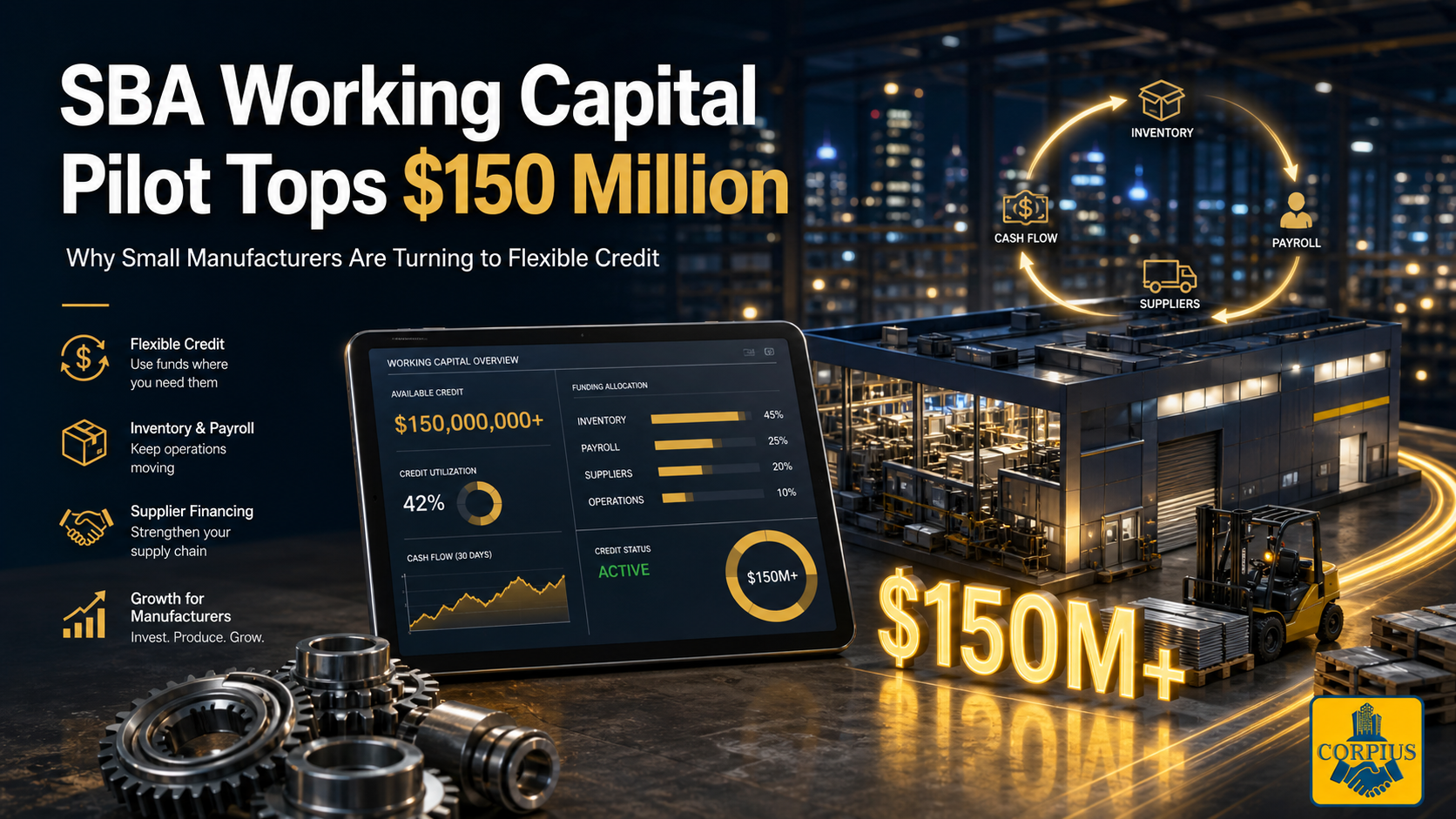
SBA Working Capital Pilot Tops $150 Million: Why Small Manufacturers Are Turning to Flexible Credit
SBA Working Capital Pilot Tops $150 Million: Why Small Manufacturers Are
Turning to Flexible Credit
The U.S. Small Business Administration announced on February 2, 2026 that its 7(a)
Working Capital Pilot (WCP) program has delivered more than $150 million in
total lending since its inception — with more than $125 million approved since
January 2025. Small manufacturers are the SBA Working Capital
Pilot's
largest user group, accounting for more than 25% of the total portfolio. The
SBA Working Capital Pilot milestone reflects a structural shift in how
capital-intensive small manufacturers are approaching working capital financing — turning to the WCP's flexible credit
structures rather than fixed-term conventional loans.
Key Takeaways: SBA
Working Capital Pilot $150 Million Milestone
·
SBA Working Capital Pilot total lending: more than $150 million since
program inception
·
$125
million approved since January 2025
·
Small manufacturers: more than 25% of total SBA Working Capital Pilot portfolio
·
Small manufacturers represent 98% of all U.S. manufacturers
·
Two SBA Working Capital
Pilot structures: asset-based
loans and transaction-based
financing
·
Transaction-based
WCP can finance up to 100% of direct costs for individual orders
·
SBA Working Capital Pilot supports domestic and international orders under a
single facility
·
Complements
the MARC program (Manufacturers' Access to Revolving Credit)
What the SBA Working
Capital Pilot Offers Small Manufacturers
The SBA Working Capital Pilot is a complement to the SBA's standard 7(a)
and 504 loan programs. Where conventional SBA loans are structured as term
loans for fixed capital expenditures, the SBA Working Capital Pilot provides revolving
credit lines designed for the irregular cash flows, order-based production cycles,
and inventory-intensive operations common in manufacturing.
Asset-Based SBA
Working Capital Pilot:
Provides working capital secured against existing business assets — inventory, accounts receivable, equipment. Allows manufacturers
to procure inventory, manage operating expenses, and offer competitive payment
terms to customers.
Transaction-Based SBA
Working Capital Pilot:
Finances specific orders or projects earlier in the sales cycle. The SBA Working
Capital Pilot can finance up to 100% of direct costs for qualifying orders — critical
for manufacturers accepting large purchase orders that require upfront
materials procurement. Both domestic and international orders are supported
under a single SBA Working Capital Pilot facility.
Why Manufacturers Are
the SBA Working Capital Pilot's Dominant Users
Small manufacturers account for more than 25% of the
SBA Working Capital Pilot portfolio despite representing only a
portion of the eligible business population. The reason is structural:
manufacturing is uniquely capital-intensive in ways that conventional term
lending addresses poorly. A manufacturer accepting a large order needs working
capital to procure raw materials before customer payment. A manufacturer
managing seasonal production needs flexible draw-and-repay capacity. The SBA
Working Capital Pilot's flexible structure maps directly onto these operational
realities.
SBA Administrator Loeffler on the SBA Working Capital
Pilot:
"Manufacturing is a growing but capital-intensive industry, which is why
SBA's Working Capital Pilot Program is playing a key role in empowering small
firms to reshore their supply chains, hire American workers, and begin growing
again."
How the SBA Working
Capital Pilot Fits the Broader Manufacturing Finance Stack
The SBA Working Capital Pilot does not operate in isolation. It sits
alongside the Manufacturers' Access to Revolving Credit (MARC), the new SBA Made in
America Loan Guarantee (effective May 1, 2026 at a 90% federal guarantee), fee waivers on 7(a) and 504 manufacturing loans through September 30, 2026, and the
Make Onshoring Great Again Portal. For a small manufacturer with both working capital needs
(SBA Working Capital Pilot, MARC) and capital expenditure plans (ITL, 7(a),
504), the full program suite covers multiple stages of the growth cycle.
How to Access the SBA
Working Capital Pilot
The SBA Working Capital Pilot is available through SBA delegated
lenders —
financial institutions approved to originate WCP loans under delegated
authority. The FY26 Program Guide and list of delegated lenders is available at
sba.gov. Small manufacturers using conventional bank credit
lines or struggling to access working capital due to asset-light balance sheets
or irregular revenue timing should evaluate the SBA Working Capital Pilot as a
complementary or replacement tool.
SBA Working Capital Pilot Tops $150 Million: Why Small Manufacturers Are
Turning to Flexible Credit
The U.S. Small Business Administration announced on February 2, 2026 that its 7(a)
Working Capital Pilot (WCP) program has delivered more than $150 million in
total lending since its inception — with more than $125 million approved since
January 2025. Small manufacturers are the SBA Working Capital
Pilot's
largest user group, accounting for more than 25% of the total portfolio. The
SBA Working Capital Pilot milestone reflects a structural shift in how
capital-intensive small manufacturers are approaching working capital financing — turning to the WCP's flexible credit
structures rather than fixed-term conventional loans.
Key Takeaways: SBA
Working Capital Pilot $150 Million Milestone
·
SBA Working Capital Pilot total lending: more than $150 million since
program inception
·
$125
million approved since January 2025
·
Small manufacturers: more than 25% of total SBA Working Capital Pilot portfolio
·
Small manufacturers represent 98% of all U.S. manufacturers
·
Two SBA Working Capital
Pilot structures: asset-based
loans and transaction-based
financing
·
Transaction-based
WCP can finance up to 100% of direct costs for individual orders
·
SBA Working Capital Pilot supports domestic and international orders under a
single facility
·
Complements
the MARC program (Manufacturers' Access to Revolving Credit)
What the SBA Working
Capital Pilot Offers Small Manufacturers
The SBA Working Capital Pilot is a complement to the SBA's standard 7(a)
and 504 loan programs. Where conventional SBA loans are structured as term
loans for fixed capital expenditures, the SBA Working Capital Pilot provides revolving
credit lines designed for the irregular cash flows, order-based production cycles,
and inventory-intensive operations common in manufacturing.
Asset-Based SBA
Working Capital Pilot:
Provides working capital secured against existing business assets — inventory, accounts receivable, equipment. Allows manufacturers
to procure inventory, manage operating expenses, and offer competitive payment
terms to customers.
Transaction-Based SBA
Working Capital Pilot:
Finances specific orders or projects earlier in the sales cycle. The SBA Working
Capital Pilot can finance up to 100% of direct costs for qualifying orders — critical
for manufacturers accepting large purchase orders that require upfront
materials procurement. Both domestic and international orders are supported
under a single SBA Working Capital Pilot facility.
Why Manufacturers Are
the SBA Working Capital Pilot's Dominant Users
Small manufacturers account for more than 25% of the
SBA Working Capital Pilot portfolio despite representing only a
portion of the eligible business population. The reason is structural:
manufacturing is uniquely capital-intensive in ways that conventional term
lending addresses poorly. A manufacturer accepting a large order needs working
capital to procure raw materials before customer payment. A manufacturer
managing seasonal production needs flexible draw-and-repay capacity. The SBA
Working Capital Pilot's flexible structure maps directly onto these operational
realities.
SBA Administrator Loeffler on the SBA Working Capital
Pilot:
"Manufacturing is a growing but capital-intensive industry, which is why
SBA's Working Capital Pilot Program is playing a key role in empowering small
firms to reshore their supply chains, hire American workers, and begin growing
again."
How the SBA Working
Capital Pilot Fits the Broader Manufacturing Finance Stack
The SBA Working Capital Pilot does not operate in isolation. It sits
alongside the Manufacturers' Access to Revolving Credit (MARC), the new SBA Made in
America Loan Guarantee (effective May 1, 2026 at a 90% federal guarantee), fee waivers on 7(a) and 504 manufacturing loans through September 30, 2026, and the
Make Onshoring Great Again Portal. For a small manufacturer with both working capital needs
(SBA Working Capital Pilot, MARC) and capital expenditure plans (ITL, 7(a),
504), the full program suite covers multiple stages of the growth cycle.
How to Access the SBA
Working Capital Pilot
The SBA Working Capital Pilot is available through SBA delegated
lenders —
financial institutions approved to originate WCP loans under delegated
authority. The FY26 Program Guide and list of delegated lenders is available at
sba.gov. Small manufacturers using conventional bank credit
lines or struggling to access working capital due to asset-light balance sheets
or irregular revenue timing should evaluate the SBA Working Capital Pilot as a
complementary or replacement tool.
CORPIUS is not just a service — it is a complete AI-driven business operating
system designed to handle everything from company formation and compliance to tax filing and operational
automation.
For the Shopify seller who has been shipping products under their personal
name, the Amazon operator whose 1099-K arrives against their Social Security
Number, the freelancer whose contracts are signed as an individual, and the
creator whose brand deals are executed without a legal entity — CORPIUS handles
the complete formation sequence and every compliance
obligation
that follows, through a single intelligent platform powered by REVOLD AI. Not a filing service that
processes paperwork and disappears. An operational system that builds the legal infrastructure correctly from the first document and
tracks every obligation, deadline, and structural requirement automatically as
the business grows. The legal foundation your online business has been
operating without is one decision away. Visit corpius.net and make it today — before the
event that makes it urgent arrives first.
Powered by AIR RISE INC & REVOLD AI — with Roman
Kravchina
and the CORPIUS team. 50 Central Park S #24A, New York, NY 10019 | +1 (347) 343-3353 | corpius.net
Share this post

Written by
Adi FishmanCOO / CMO & Brand Manager
Co-founder and Brand Manager. Responsible for operations, marketing strategy, and building the CORPIUS brand.
Related Posts
SBIR and STTR Are Reauthorized Through 2031: What the New Law Means for Startups | CORPIUS
5 min read

How Fast Can You Register a US Company? Real Timeline Explained
7 min read

US Company Formation for Non-Residents: Everything You Need to Know
8 min read
Ready to Form Your Business?
Our experts are here to guide you through every step.