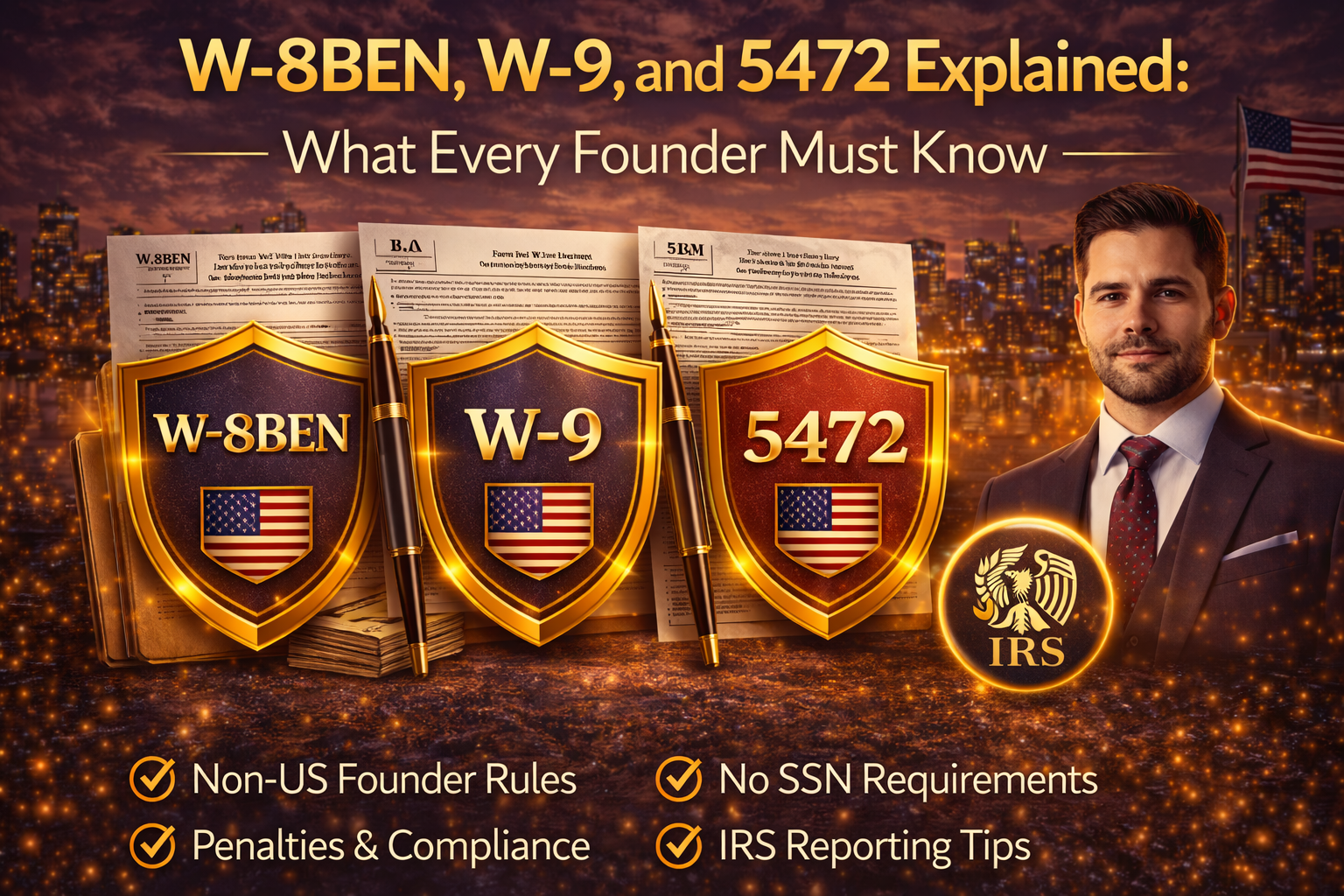
W-8BEN, W-9, and 5472 Explained: What Every Founder Must Know
W-8BEN, W-9, and 5472 Explained: What Every Founder Must Know
Three IRS forms sit at the intersection of every serious international founder's US business journey. Most founders encounter them at the worst possible moment — during bank onboarding, mid-contract with a US client, or in the middle of a compliance audit — without any prior context for what they mean, why they exist, or what happens when they are filed incorrectly. Understanding W-8BEN, W-9, and Form 5472 before they are requested is not bureaucratic preparation. It is a competitive and legal necessity.
Why These Three Forms Define Your US Tax Identity
The US tax system is built on identification and classification. Before the IRS can determine what a person or entity owes — or whether they owe anything at all — it needs to know who they are, where they are from, and in what capacity they are operating inside the American economy. W-8BEN, W-9, and Form 5472 are the instruments through which that classification happens for founders with US companies.
Each form serves a distinct function and applies to a distinct situation. W-9 is the domestic identification form — used when a US person or US-resident entity is providing services or receiving payments inside the United States. W-8BEN is its international counterpart — used when a foreign individual certifies their non-US status to a withholding agent and, where applicable, claims the benefit of a tax treaty. Form 5472 is neither a payment form nor a certification — it is a mandatory annual information return that documents the financial relationship between a foreign-owned US LLC and its foreign owner.
Confusing these forms, submitting the wrong one, or failing to submit any of them creates consequences that range from incorrect withholding on payments to $25,000 federal penalties. The distinction between them is not administrative detail — it is the foundation of a foreign founder's US tax compliance posture.
W-9: The Form That Identifies US Persons to Payers
Form W-9 — Request for Taxpayer Identification Number and Certification — is the domestic baseline. When a US business pays another US person or entity for services, rent, interest, dividends, or other reportable income, the payer is required to collect a W-9 from the payee. The form collects the payee's legal name, business name if applicable, entity type, address, and taxpayer identification number — either a Social Security Number or an Employer Identification Number.
The payer uses the W-9 information to prepare Form 1099 at year-end, reporting the payment to the IRS. This is the mechanism through which the IRS tracks income paid to US persons outside of traditional employment. If you have a US LLC with an EIN and a US client pays you more than $600 in a calendar year for services, that client will request a W-9 from your company. Providing it is not optional — payers are required to withhold 24% backup withholding on payments to payees who fail to provide a valid W-9.
For foreign founders operating US LLCs, the W-9 question is more nuanced than it appears. A US LLC owned by a foreign individual is still a US entity — and in most cases, the LLC itself provides a W-9 using its EIN, not a W-8BEN. The foreign status of the owner does not automatically make the LLC a foreign entity for withholding purposes. This distinction matters enormously when US clients are deciding which form to request, and it is a source of significant confusion in practice. CORPIUS guides clients through this classification during onboarding precisely because an incorrect form submission can disrupt payment flows and trigger unnecessary withholding at the worst possible time.
W-8BEN: The Form That Establishes Foreign Status and Claims Treaty Benefits
Form W-8BEN — Certificate of Foreign Status of Beneficial Owner for United States Tax Withholding and Reporting — is the form a foreign individual submits to a US withholding agent to certify that they are not a US person and to claim, where applicable, reduced withholding rates under an applicable tax treaty.
The withholding agent in this context is any US person or entity that pays income to a foreign person — a bank, a brokerage, a payment platform, or a business making payments to a foreign contractor. By default, the IRS requires withholding agents to withhold 30% on FDAP income — Fixed, Determinable, Annual, or Periodical income from US sources, including dividends, interest, rents, and royalties — paid to foreign persons. The W-8BEN certifies foreign status and triggers the withholding agent's obligation to apply the correct rate, which may be lower if a tax treaty applies.
The form itself requires the foreign individual's name, country of citizenship, permanent address, country of residence for tax purposes, and — if claiming treaty benefits — the specific treaty article and reduced rate being claimed. W-8BEN is valid for three years from the date of signature, after which it must be renewed. Failure to renew means the withholding agent defaults back to 30% withholding until a new form is on file.
There is a related form — W-8BEN-E — which applies to foreign entities rather than foreign individuals. A foreign-owned US LLC does not use W-8BEN-E, because the LLC is a US entity. A foreign company that has no US formation and is receiving payments from a US source uses W-8BEN-E. This distinction is another area where founders frequently submit the wrong form and create withholding errors that take months to correct.
Form 5472: The Mandatory Annual Filing With a $25,000 Penalty
Form 5472 — Information Return of a 25% Foreign-Owned U.S. Corporation or a Foreign Corporation Engaged in a U.S. Trade or Business — is in a different category from W-9 and W-8BEN. It is not submitted to a payer or a bank. It is filed directly with the IRS as part of an annual compliance obligation, and it applies to every foreign-owned single-member LLC in the United States regardless of whether the company had any income, any activity, or any transactions of any kind.
The form was extended to cover foreign-owned single-member LLCs in 2017, as part of Treasury regulations designed to increase transparency around foreign ownership of US entities. Before 2017, single-member LLCs were disregarded entities with minimal federal filing requirements. After the regulatory change, they became subject to one of the most consequential information reporting requirements in the US tax code.
Form 5472 documents reportable transactions between the LLC and its foreign owner. Reportable transactions include capital contributions — money the owner puts into the company — distributions, loans in either direction, payments for services, and any other transfer of money or property between the LLC and its related foreign parties. If none of these transactions occurred during the year, the form is still required — filed with a notation reflecting the absence of reportable transactions.
The filing is submitted together with a pro-forma Form 1120 — a simplified version of the corporate income tax return that serves as the vehicle for the 5472 submission. The combined filing is due April 15 of the year following the tax year, with an extension to October 15 available. The penalty for failure to file is $25,000 per LLC per year, assessed per violation, with no graduated structure and no revenue threshold. A company that earned nothing and transacted nothing still owes this filing — and the IRS has demonstrated consistent willingness to enforce the penalty against foreign-owned LLCs that miss it.
CORPIUS treats Form 5472 compliance as a core annual maintenance function for every foreign-owned LLC on its platform, integrated into the same workflow as registered agent renewal and state annual reports — because the cost of missing it is categorically disproportionate to the cost of filing it.
How the Three Forms Interact in Practice
Understanding each form in isolation is necessary. Understanding how they interact in the real operating environment of a foreign-owned US company is what separates founders who navigate US compliance smoothly from those who encounter expensive surprises.
Consider a common scenario: a founder based in the UAE forms a Wyoming LLC through CORPIUS, obtains an EIN, and opens a Mercury business account. The founder begins invoicing US clients for software development services. The LLC earns $120,000 in its first year.
The US clients will request a W-9 from the LLC before making any payments. The LLC provides its W-9 using its EIN — the LLC is a US entity, not a foreign one, so W-9 is the correct form. The clients issue Form 1099 to the LLC at year-end.
The LLC's income from US clients for services performed outside the United States is analyzed for source and connection. If the work was performed entirely outside the US and the LLC is not engaged in a US trade or business, the income may not be subject to US federal income tax. The founder files Form 5472 with a pro-forma 1120 by April 15, documenting any capital contributions or distributions between themselves and the LLC during the year.
If the founder also holds a personal investment account with a US brokerage — separate from the LLC — and that account pays dividends, the brokerage will request a W-8BEN from the founder individually. The founder provides W-8BEN certifying UAE residence, and if a US-UAE tax treaty applies, claims the reduced withholding rate.
Three forms, three distinct functions, three distinct submitting parties — all running simultaneously, all with consequences for errors.
Additional Resources & Context
Related Topics Worth Exploring
- Form 1099 and backup withholding: what US clients are required to report about payments to your LLC
- The W-8BEN renewal cycle: how to track the three-year validity window and avoid default withholding
- Form 5472 reportable transactions: a line-by-line breakdown of what must be disclosed
Key Frameworks
The entity vs. owner distinction: US tax forms apply either to the entity (the LLC) or to the owner as an individual. W-9 and Form 5472 relate to the LLC. W-8BEN relates to the foreign individual owner. Mixing these up — submitting a W-8BEN when a client requests a W-9 for the LLC — creates withholding errors and signals to the payer that they are dealing with a foreign entity subject to 30% withholding, which is incorrect for a US LLC.
The proactive filing posture: W-8BEN and W-9 are reactive — submitted when requested by a payer. Form 5472 is proactive — it must be filed by the deadline whether or not anyone asks for it. Building the 5472 deadline into the annual calendar from the moment of LLC formation is the only reliable compliance approach.
Key Terminology
W-9 — IRS form used by US persons and entities to certify their taxpayer identification number to a payer. Triggers 1099 reporting at year-end. Required by payers before making reportable payments.
W-8BEN — IRS form used by foreign individuals to certify non-US status and claim applicable tax treaty benefits on US-source income. Valid for three years. Submitted to withholding agents, not to the IRS directly.
W-8BEN-E — The entity version of W-8BEN. Used by foreign companies — not by US-registered LLCs with foreign owners.
Form 5472 — Annual IRS information return for foreign-owned US single-member LLCs. Documents transactions between the LLC and its foreign owner. Penalty: $25,000 per year for non-filing.
Withholding Agent — Any US person or entity that pays US-source income to a foreign person and is responsible for withholding the appropriate tax before remitting payment.
FDAP Income — Fixed, Determinable, Annual, or Periodical income. The category of US-source passive income subject to 30% withholding unless reduced by treaty.
Backup Withholding — A 24% withholding rate applied by US payers when a payee fails to provide a valid W-9. Avoided by submitting the correct form promptly.
Get the Forms Right Before Someone Else Gets Them Wrong for You
The most expensive version of a tax form error is not the one you make — it is the one a withholding agent makes on your behalf because you submitted the wrong form or no form at all. Once a payer withholds 30% from a payment because no W-8BEN was on file, or withholds 24% backup withholding because no W-9 was provided, recovering that money requires filing for a refund through a process that takes months and requires its own documentation.
Form 5472 errors are worse because they have no withholding agent buffer. There is no intermediary to catch the mistake. The IRS assesses the penalty directly against the LLC, and the founder discovers it during correspondence that arrives without warning.
CORPIUS integrates all three compliance layers — W-9 readiness, W-8BEN guidance for individual owners, and annual Form 5472 filing — into its platform infrastructure for foreign-owned US companies. The goal is not to make compliance simple — it is to make non-compliance structurally impossible for the founders who build their US operations on the platform.
All of this is handled for you by CORPIUS — a complete AI-powered Full Stack Business Solution for U.S. company formation, tax management, and compliance.
Powered by REVOLD AI · Built by AIR RISE INC
→ corpius.net
CORPIUS is not just a service — it is a complete AI-driven business operating system designed to handle everything from company formation and compliance to tax filing and operational automation. For the Shopify seller who has been shipping products under their personal name, the Amazon operator whose 1099-K arrives against their Social Security Number, the freelancer whose contracts are signed as an individual, and the creator whose brand deals are executed without a legal entity — CORPIUS handles the complete formation sequence and every compliance obligation that follows, through a single intelligent platform powered by REVOLD AI. Not a filing service that processes paperwork and disappears. An operational system that builds the legal infrastructure correctly from the first document and tracks every obligation, deadline, and structural requirement automatically as the business grows. The legal foundation your online business has been operating without is one decision away. Visit corpius.net and make it today — before the event that makes it urgent arrives first.
Powered by AIR RISE INC & REVOLD AI — with Roman Kravchina and the CORPIUS team. 50 Central Park S #24A, New York, NY 10019 | +1 (347) 343-3353 | corpius.net
Share this post

Written by
Roman KravchinaCEO / CMO / CTO & Lead Architect & Senior Software Developer
Co-founder of AIR RISE INC & CORPIUS. Full-stack architect with expertise in scalable digital products, brand strategy, and technology leadership.
Related Posts

IRS Expands Tax Pro Account for Firms and Tax-Prep Businesses: What Changed in 2026 | CORPIUS
5 min read
IRS Updates 2026 Form 1099 Instructions: What Small Businesses Need to Know About New Reporting Fields | CORPIUS
5 min read

IRS Opens the Next Qualified Opportunity Zone Nomination Cycle: What States and Investors Need to Know | CORPIUS
5 min read
Ready to Form Your Business?
Our experts are here to guide you through every step.