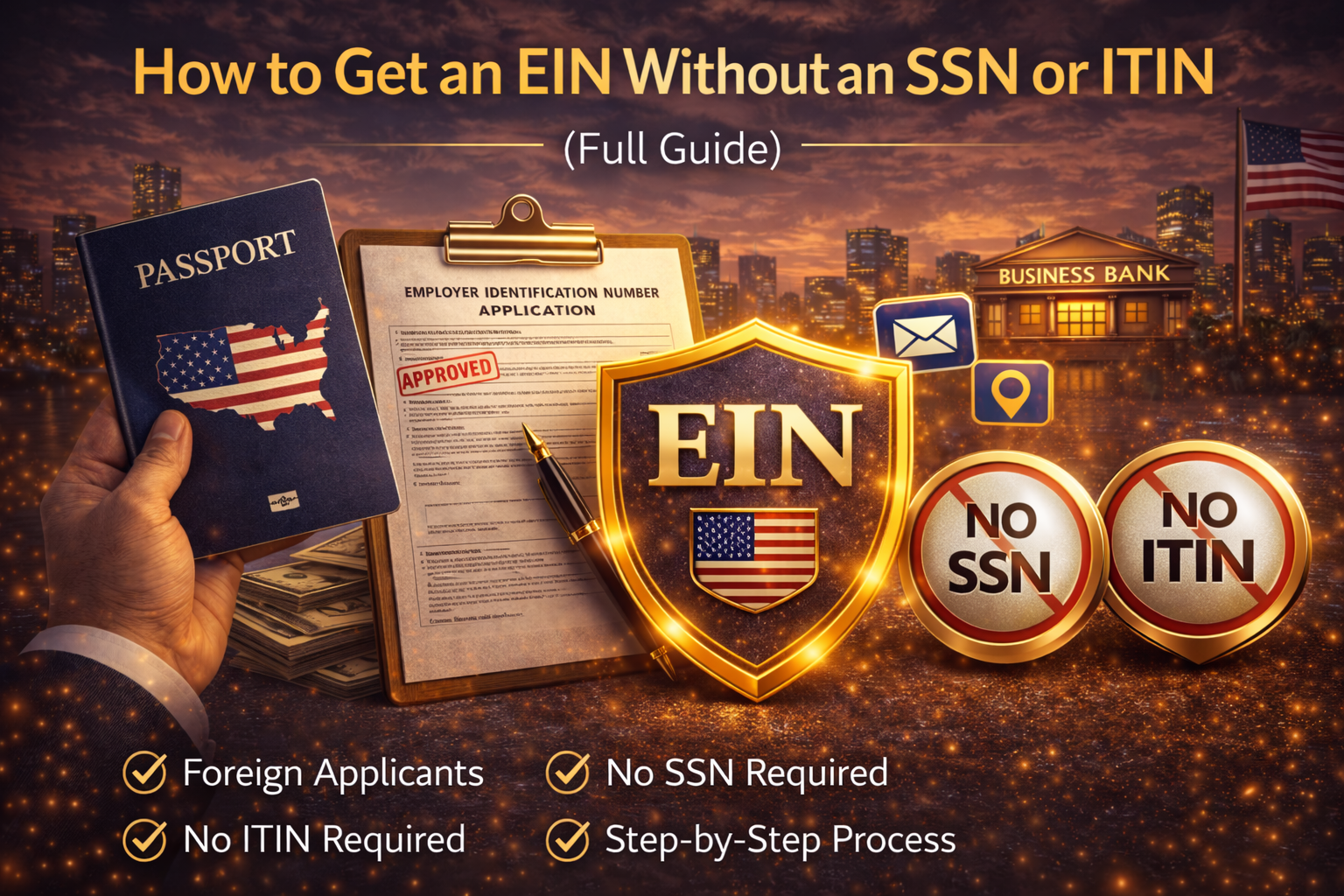
How to Get an EIN Without an SSN or ITIN (Full Guide)
How to Get an EIN Without an SSN or ITIN (Full Guide)
There is one number that stands between a newly formed US company and its first real business transaction: the Employer Identification Number. Without it, there is no bank account, no Stripe integration, no payroll, and no tax filing. For US residents, getting an EIN takes about five minutes online. For everyone else — the international founder, the non-resident entrepreneur, the foreign national building a US business from abroad — the standard path is closed, and a different route must be taken. This guide explains exactly what that route looks like, step by step.
What an EIN Is and Why Every US Company Needs One
The Employer Identification Number is a nine-digit federal tax identification number issued by the Internal Revenue Service. Despite its name, you do not need employees to need an EIN. Every US business entity — LLC, corporation, partnership — requires one for fundamental operations that have nothing to do with payroll.
Banks require an EIN to open a business account. Payment processors including Stripe, PayPal Business, and Braintree require it during merchant onboarding. The IRS requires it for business tax filings. Vendors and clients issue 1099 forms using it. E-commerce platforms including Amazon Seller Central require it for US seller accounts. In practical terms, an EIN is not optional — it is the operational on-switch for a US company.
The confusion for non-residents begins with how the IRS designed its EIN application system. The agency's online EIN application — fast, free, and instant — is available only to applicants with a valid Social Security Number or Individual Taxpayer Identification Number. Those are US-resident identifiers. A founder in Germany, Nigeria, Singapore, or Colombia has neither, which means the online portal is unavailable to them by default. What remains are three alternative pathways — and knowing which one applies to your situation determines whether you wait ten days or ten weeks.
The Three Pathways for Non-Residents Without an SSN or ITIN
Understanding the mechanics of each pathway is essential before choosing one. They differ significantly in speed, reliability, and the level of preparation required.
Pathway 1: IRS Form SS-4 by Fax The most commonly recommended method for non-residents is submitting IRS Form SS-4 — the standard EIN application — by fax to the IRS's designated international fax line. The form requests basic entity information: legal name, address, type of entity, state of formation, reason for applying, and the responsible party's identification details. For non-residents, the responsible party identification section is where most errors occur. Non-residents list their foreign passport number and country of issuance in place of an SSN or ITIN — a valid approach, but one that must be completed precisely to avoid rejection.
Processing time for fax applications varies. The IRS targets four business days for fax responses, but real-world timelines frequently run one to four weeks depending on application volume and the completeness of the submission. An incomplete or incorrectly completed SS-4 adds significant delay — the IRS will either reject the application outright or send a written request for additional information, which can add another two to six weeks.
Pathway 2: IRS Form SS-4 by Mail Mail is the slowest pathway and should generally be avoided when speed matters. The IRS processes mailed EIN applications in four to five weeks under normal circumstances. During high-volume periods — the first quarter of the calendar year, for instance, when new businesses are forming in large numbers — processing can stretch to eight weeks or beyond. The only advantage of mail over fax is that it is universally accessible without access to a fax machine or fax service. Given the availability of online fax services, this advantage has largely evaporated.
Pathway 3: Phone Application via the IRS International Tax Office This is the fastest available method for non-residents and the least well-known. The IRS maintains a dedicated international telephone line — +1 (267) 941-1099 — specifically for taxpayers outside the US. Non-resident applicants can call this number, speak directly with an IRS representative, and receive an EIN verbally during the call, which is then confirmed in writing. The entire process can be completed in a single call.
The catch is availability. The international line operates Monday through Friday, 6:00 AM to 11:00 PM Eastern Time. Wait times vary considerably. Callers must have the completed SS-4 information ready before calling — the representative will ask for all the same information the form requires. Having an incomplete answer to any field will result in the call being terminated and rescheduled. For founders who prepare correctly, this pathway compresses the EIN wait from weeks to a single business day.
CORPIUS navigates this process on behalf of clients, handling the SS-4 preparation, the IRS communication, and the confirmation documentation — removing the single biggest delay point in non-resident company formation.
Completing IRS Form SS-4 Correctly as a Non-Resident
The SS-4 is a two-page form with seventeen numbered fields. Most are straightforward. Several require specific attention for non-resident applicants.
Line 1 — Legal name of entity: Enter the exact company name as it appears on your state formation documents. A single character discrepancy between your Articles of Organization and your SS-4 can trigger a processing delay.
Line 3 — Executor, administrator, trustee, etc.: For a single-member LLC, this is typically left blank. For a corporation, enter the name of a principal officer.
Line 7a — Name of responsible party: This is the individual the IRS holds accountable for the entity's federal tax obligations. For a founder-owned LLC or corporation, this is the founder.
Line 7b — SSN, ITIN, or EIN: Non-residents without an SSN or ITIN write "Foreign" or "N/A" in this field and attach a note explaining that the responsible party is a foreign national without a US tax identification number. Some IRS representatives request a passport number in this field — have it ready regardless.
Line 9a — Type of entity: Select the appropriate classification. LLC members should select "Limited Liability Company" and specify the number of members. Single-member LLCs are classified differently from multi-member LLCs for default tax purposes — this distinction matters.
Line 10 — Reason for applying: For new companies, select "Started new business." For companies that already exist but are applying for an EIN for the first time, select "Banking purpose" if banking is the immediate need — this framing sometimes accelerates processing.
Line 11 — Date business started: Use the date your state formation documents were approved, not the date you began operations.
Common Mistakes That Delay EIN Applications
The IRS rejects or delays a significant percentage of non-resident EIN applications for preventable reasons. The most frequent errors follow a consistent pattern.
Mismatched entity names between the SS-4 and state formation documents generate automatic flags. The IRS cross-references the entity name against available records — a name that does not match exactly is treated as a potential discrepancy requiring manual review.
Leaving the responsible party identification section ambiguous is the second most common problem. The IRS needs a human being it can identify as accountable for the entity. Non-residents must be clear and consistent: full legal name as it appears on the passport, foreign status explicitly noted, passport number provided if requested.
Incorrect entity classification creates downstream tax problems that can be difficult and expensive to correct. A single-member LLC and a multi-member LLC have different default tax classifications — disregarded entity versus partnership — with materially different filing obligations. Selecting the wrong type on the SS-4 does not just delay the application; it creates a tax classification mismatch that may require a separate correction filing.
Using an incorrect mailing address creates a paper trail that leads nowhere. The address on the SS-4 should be the company's registered address — typically the registered agent's address — not a personal foreign address. The IRS will send written confirmation to whatever address is listed, and written correspondence sent to a foreign address can take weeks to arrive.
What Happens After You Receive Your EIN
The EIN arrives either verbally during a phone application, via fax confirmation, or in a written letter from the IRS. In each case, the IRS assigns what is called a CP 575 notice — the official EIN confirmation letter. This document is important. Banks and financial institutions require it during account opening. Some government agencies require it for licensing. Keep the original; replacements require a formal request process.
With EIN in hand, the company is ready for US banking. Mercury, Relay, and Brex all accept applications from non-resident-owned entities. The standard application package requires the Articles of Organization or Certificate of Incorporation, the EIN confirmation, the operating agreement, and basic information about the business model. Applications with complete documentation process faster — Mercury typically responds within two to five business days.
CORPIUS coordinates the complete post-EIN sequence as part of its formation platform, ensuring that the transition from EIN confirmation to operational banking account is as compressed as possible.
Additional Resources & Context
Related Topics Worth Exploring
- How to open a US business bank account as a non-resident after receiving your EIN
- Form 5472: the annual IRS filing required for foreign-owned single-member LLCs
- The difference between a disregarded entity and a partnership for tax classification purposes
Key Frameworks
The preparation multiplier: Every minute spent preparing a complete and accurate SS-4 before contacting the IRS saves an average of five to ten days of reprocessing time. Preparation is not overhead — it is the fastest path forward.
The responsible party principle: The IRS thinks in terms of human accountability. Every question about who the responsible party is, what their identification is, and where they can be reached should be answered with maximum clarity. Ambiguity is always interpreted as incompleteness.
Key Terminology
EIN (Employer Identification Number) — A nine-digit federal tax identification number issued by the IRS, required for virtually all US business operations regardless of whether the company has employees.
SSN (Social Security Number) — A US government-issued identification number for citizens and eligible residents. Required for the IRS online EIN portal — unavailable to non-residents.
ITIN (Individual Taxpayer Identification Number) — An IRS-issued number for individuals who must file US taxes but do not qualify for an SSN. Non-resident founders who have filed US tax returns may have one; most new non-resident founders do not.
Form SS-4 — The IRS application form for an EIN. The document non-residents must complete and submit by fax, mail, or phone to obtain their company's tax identification number.
CP 575 — The official IRS EIN confirmation letter. The primary document banks and institutions accept as proof of EIN assignment.
Responsible party — The individual the IRS designates as accountable for a company's federal tax obligations. For founder-owned entities, this is the founder.
The EIN Is Not the Finish Line — It Is the Starting Point
The EIN unlocks the operational layer of a US company. It is the credential that turns a state filing into a functional business entity — one that can bank, process payments, hire contractors, file taxes, and operate inside the world's largest commercial ecosystem.
For non-residents, obtaining that credential without an SSN or ITIN is entirely possible. It requires understanding which pathway to use, preparing the SS-4 with precision, and knowing how to navigate IRS communication as a foreign applicant. Done correctly, the process takes days, not months.
CORPIUS handles this process as a core part of its formation infrastructure — because a US company that cannot get its EIN in a reasonable timeframe is not a company that can compete. The founders who move fastest are those who treat EIN procurement not as a bureaucratic inconvenience but as a solvable operational problem with a clear, documented solution.
Share this post

Written by
Roman KravchinaCEO / CMO / CTO & Lead Architect & Senior Software Developer
Co-founder of AIR RISE INC & CORPIUS. Full-stack architect with expertise in scalable digital products, brand strategy, and technology leadership.
Related Posts

IRS Expands Tax Pro Account for Firms and Tax-Prep Businesses: What Changed in 2026 | CORPIUS
5 min read
IRS Updates 2026 Form 1099 Instructions: What Small Businesses Need to Know About New Reporting Fields | CORPIUS
5 min read

IRS Opens the Next Qualified Opportunity Zone Nomination Cycle: What States and Investors Need to Know | CORPIUS
5 min read
Ready to Form Your Business?
Our experts are here to guide you through every step.