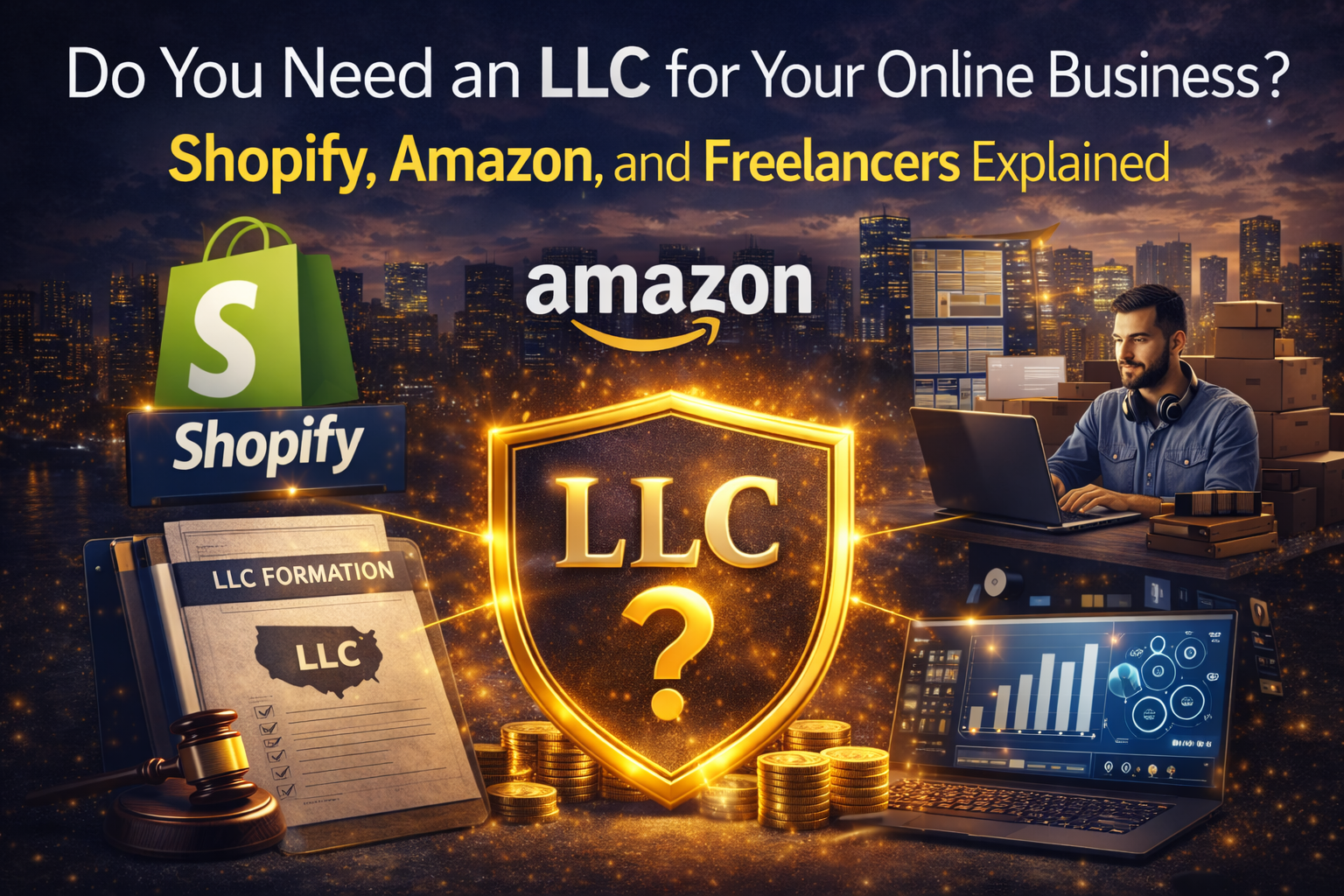
Do You Need an LLC for Your Online Business? Shopify, Amazon, and Freelancers Explained
The Law Has Already Classified Your Online Business. It Did Not Ask for Your Permission.
There is a legal event that occurs the moment an online transaction generates revenue — and it occurs whether or not the person behind it is aware of it, prepared for it, or has made any decision whatsoever about business structure. The American legal system does not wait for founders to organize themselves. It classifies commercial activity automatically, assigns a legal structure by default, and leaves the individual entirely responsible for the consequences of a structure they never chose and may not understand.
That structure is sole proprietorship. It is not a business entity in any meaningful operational sense. It is the law's way of saying: this person is conducting commerce and has not told us anything different, so we will treat their business and their personal life as the same thing. Every asset. Every account. Every property. Every future earning. All of it — accessible to anyone with a valid legal claim against the commercial activity that individual is conducting.
The Shopify store that shipped a product last Tuesday. The Amazon inventory sitting in a fulfillment center in Ohio. The freelance contract signed last month. The brand deal executed by a creator with 300,000 followers. Every one of these is a legal event generating exposure that default law addresses in the least favorable possible way for the individual conducting it.
CORPIUS is not interested in recycling the standard LLC guide that every formation service has published in one form or another for the past decade. This is a different kind of analysis — built from the specific commercial realities of the digital economy in 2026, the specific legal exposure each business model generates, and the specific cost of continuing to operate under a default that was never designed to protect the people living inside it.
What Sole Proprietorship Actually Is When You Remove the Legal Language
Strip the terminology away and sole proprietorship is a single, operationally significant fact: there is no line between you and your business. Not legally. Not financially. Not in terms of what can be taken from you if something goes wrong.
The courts do not recognize a distinction between what your business owes and what you owe. A plaintiff's attorney pursuing a product liability claim against your Shopify store does not need to limit the claim to your business bank account balance. They can pursue your personal savings. Your car. The equity in your home if you own one. Your future income streams. The commercial activity you conducted through your personal identity gives them access to your personal financial life in its entirety.
Most founders who understand this in the abstract do not feel its weight until something specific makes it concrete. A supplement reseller whose customer reports an adverse reaction. A dropshipper whose third-party supplier shipped a defective batch that caused property damage. A freelance developer whose code was in production when a security breach exposed client data. A content creator whose sponsored post was later found to violate FTC disclosure requirements and named the creator personally in the resulting investigation.
None of these are exotic scenarios. They are the ordinary operational risks of running a digital business — risks that an LLC addresses structurally and that sole proprietorship leaves completely exposed. The difference between the two outcomes, in the same scenario, is entirely a function of whether the entity existed before the event occurred. After the event, the decision is no longer available.
Shopify: The Three Legal Exposures Every Merchant Carries and One Structure That Addresses All of Them
The Shopify ecosystem creates three distinct categories of legal exposure that are architecturally independent of each other but that sole proprietors carry simultaneously, on personal credit, from the first fulfilled order.
The product chain. American product liability law does not restrict claims to manufacturers. It follows the chain of distribution. Every party that placed a product into commerce — sourced it, listed it, sold it, shipped it — carries potential liability for harm that product causes. A Shopify merchant who private-labels a product they did not manufacture, resells imported goods they did not design, or distributes merchandise they did not produce is a link in that chain. The claim that arises from a product failure does not stop at the manufacturer's address. It follows the chain until it finds a party with assets worth pursuing. Under sole proprietorship, that party is you personally, and your assets are your personal assets.
The payment layer. Every chargeback, every fraud dispute, every account hold that a payment processor initiates is processed against the identity on file with the merchant account. For a sole proprietor, that is a personal Social Security Number, a personal bank account, and a personal financial identity that a payment processor can freeze, hold, or report against in ways that affect personal credit, personal banking relationships, and personal tax reporting. An LLC merchant account is a legal entity with its own EIN and its own banking relationship — one that absorbs payment infrastructure events without transmitting them directly into the owner's personal financial life.
The international access barrier. For non-US founders building Shopify businesses targeting American consumers, the LLC is not a protection decision — it precedes the protection question entirely. Shopify Payments, Stripe's US merchant infrastructure, and the banking relationships that US payment processing requires are gated behind US entity credentials that a foreign individual without a US LLC cannot provide. The entity is the access credential. The liability protection is the operational benefit that comes with it — significant, but secondary to the market access the entity unlocks in the first place.
An LLC resolves all three simultaneously. One filing, one EIN, one business banking relationship, one legal entity that stands between the commercial activity and the person who built it.
Amazon FBA: Platform Dependency, Disbursement Risk, and the Tax Document That Arrives Under Your Social Security Number
Amazon's third-party seller ecosystem has a legal architecture that most FBA operators do not study carefully until they encounter a problem within it. The platform controls disbursement timing, account standing, and policy compliance — and all of those controls operate against the identity credentials registered at account enrollment.
A sole proprietor's Amazon account is registered against personal identification. When Amazon suspends an account, it is suspending access to funds associated with a personal Social Security Number. When Amazon holds disbursements during a compliance review, it is holding money that exists in the financial record under a personal tax identity. When Amazon terminates a seller relationship and issues a final disbursement after the deduction of fees, chargebacks, and reserves, that transaction is reported against the individual's personal tax profile.
The operational risk embedded in that architecture is not hypothetical. Amazon's compliance enforcement has become significantly more aggressive across multiple seller categories. Accounts can be suspended with 24-hour notice for policy determinations that sellers frequently contest successfully — but the contest period, during which funds are held, can extend weeks or months. For a sole proprietor with personal financial obligations, a multi-week Amazon disbursement hold is a personal financial crisis. For an LLC with a business banking relationship and a separation between business funds and personal funds, it is a business problem — serious, requiring attention, but contained within the entity's financial perimeter.
The product liability dimension of FBA has shifted materially as Amazon's legal exposure from marketplace products has attracted regulatory and judicial attention. Amazon has responded by strengthening seller indemnification requirements, tightening insurance mandates in high-risk categories, and updating seller agreements to transfer more explicit liability responsibility to the merchant of record. An FBA seller in electronics, health and beauty, children's products, or food categories operating at meaningful inventory volume without an LLC is accepting personal unlimited liability for product claims in categories that product liability attorneys actively monitor for exactly this reason.
Then there is the tax document. Amazon issues Form 1099-K against the tax identification number on file when transaction volume exceeds IRS reporting thresholds. For a sole proprietor, that 1099-K arrives against a personal Social Security Number, flows onto Schedule C of the personal return, and generates self-employment tax on net earnings at a rate that compounds against income tax liability. An Amazon seller generating $180,000 in net annual income from FBA operations is paying self-employment tax on that income under sole proprietorship in a way that an LLC with an S-Corporation election, at that revenue level, can legally restructure — separating a portion of that income into profit distributions not subject to self-employment tax. The annual tax savings that restructuring produces, calculated against the formation and maintenance cost of the LLC and the payroll infrastructure the S-Corp election requires, consistently exceeds those costs at that revenue level by a multiple. The LLC does not eliminate the tax obligation. It creates the legal architecture within which the obligation can be managed rather than simply absorbed.
Freelancers: The Three Conversations Nobody Has Until a Contract Goes Wrong
The freelance LLC conversation has three dimensions that are almost always discussed separately — liability protection, professional credibility, and tax structure — as if each existed independently of the others. They do not. They are three outputs of the same decision, and they become visible simultaneously the moment a client relationship generates a dispute.
The contract dispute dimension. A freelancer operating under sole proprietorship signs client agreements as an individual. When a client refuses payment, disputes deliverables, or pursues damages for alleged service failure, the dispute is between two individuals. The freelancer's personal reputation, personal credit standing, and personal legal liability are the subject of the proceeding. Collections against an unpaid invoice, when pursued against an individual rather than an entity, involve the individual's personal financial identity in ways that affect credit scores, banking relationships, and future employment and contracting prospects.
A freelancer operating through an LLC signs the same agreements under the entity's name. The LLC issues the invoice. The LLC is the party in any subsequent dispute. Collections activity, judgment enforcement, and litigation all operate against the entity rather than the individual — which is exactly the function that a limited liability structure exists to provide, and exactly the function that sole proprietorship cannot replicate under any circumstances.
The professional liability dimension. Knowledge-based service providers — strategy consultants, software architects, financial analysts, marketing professionals, UX designers, business writers working under commercial license — generate professional liability exposure through the nature of their work. A consultant whose framework informed a business decision that produced measurable harm. A developer whose code was in production when a security incident occurred. A financial analyst whose modeling contributed to a capital allocation decision that failed. These are not catastrophic or unusual scenarios — they are the ordinary professional risk of doing consequential work for clients who make significant decisions based on it.
Under sole proprietorship, the claim that arises from professional work failure reaches the individual without a legal barrier between the claim and the individual's personal assets. Under an LLC that is properly maintained — with separate banking, consistent entity usage across all client communications and contracts, and documented operating decisions — the same claim must first navigate the entity structure before accessing the member personally. Courts do pierce that structure when it is used improperly or maintained negligently. For freelancers who take the entity seriously — treating it as a real legal structure rather than a name change — the protection holds against ordinary professional liability claims with meaningful consistency.
The enterprise access dimension. The clients who pay the highest rates for professional services are, almost without exception, the clients whose vendor qualification processes assume the existence of a formal legal entity. Enterprise procurement portals require an EIN for vendor registration. Government contracting programs require entity verification. Commercial counterparties with legal counsel involved in vendor selection require a business entity named as an additional insured on liability coverage. A sole proprietor cannot satisfy those requirements in ways that are equivalent to an LLC satisfying them — because the requirements exist precisely to filter vendors by the presence of formal legal and operational structure.
The freelancer who forms an LLC does not simply gain liability protection. They gain eligibility for a tier of client relationships that sole proprietors are structurally excluded from — a commercial access benefit that, for a single high-value enterprise engagement, can produce returns that exceed the lifetime cost of the entity.
The Creator Economy's Unaddressed Legal Infrastructure Problem
The monetized creator is, in commercial terms, a multi-revenue-stream business operating intellectual property, managing contractor relationships, executing brand partnership agreements, and holding digital assets with measurable licensing value. Almost none of the legal infrastructure required to manage that commercial complexity exists for a creator operating under sole proprietorship — and the industry that built the creator economy has shown no particular urgency about changing that.
A creator with brand partnership agreements, merchandise operations, content licensing deals, and a team of freelance editors and producers is running a business with more operational complexity than many traditional small businesses that formed legal entities on their first day. The partnership agreements are executed by the creator personally. The licensing contracts are signed in the creator's personal name. The merchandise inventory is a personal asset. The platform revenue streams are reported against a personal Social Security Number. Every commercial dimension of the operation is personally merged with the individual conducting it.
The LLC restructures that merger at the legal entity level. Brand partnership agreements are executed by the entity — a distinction that matters when a brand counterparty seeks to enforce indemnification provisions or claims damages for content that failed to meet agreed specifications. Licensing contracts are held by the entity — which can be structured, transferred, or valued independently of the creator's personal identity. Merchandise inventory is a business asset — meaning its value, its liability exposure, and its eventual disposition are part of the entity's commercial life rather than the creator's personal financial life.
The strategic dimension that most creator-focused financial content ignores entirely: a creator's audience relationship and content library held within a properly structured LLC has transferable commercial value. The entity can be sold. The IP can be licensed under terms that survive the creator's departure from active content production. The brand can be acquired by a media company or rolled into a larger creator network. None of these outcomes are available to a sole proprietor whose entire commercial existence is legally merged with their personal identity — because you cannot separate what has never been separated.
The Precise Moment the LLC Stops Being Optional
The standard advice — form an LLC when the business gets serious, when revenue reaches a threshold, when the founder feels ready — contains a structural error that produces real harm with predictable consistency. Liability exposure does not accumulate proportionally with revenue. It accumulates with commercial activity and becomes consequential with events — not with income levels.
The correct framing, built from how liability law actually operates rather than how formation marketing presents it: the LLC stops being optional the moment the business conducts any transaction that could generate a claim, holds any asset worth protecting, or operates under any contract with a counterparty who has legal standing to seek damages. That description covers every Shopify sale, every Amazon shipment, every signed freelance agreement, and every brand deal signed by a creator from their first day of monetization.
Revenue level determines the tax structure analysis. It does not determine whether the liability exposure that makes an LLC valuable already exists. That exposure precedes revenue. It arrives with the first commercial act — and it waits, patient and structurally unlimited, for the event that makes its presence consequential.
The Compounding Cost of Staying a Sole Proprietor Across Three Dimensions
The decision to remain a sole proprietor is not a cost-free decision. It is a decision to absorb three compounding costs that become visible at different points in the business lifecycle and that the LLC's formation and maintenance costs would have eliminated.
The liability cost is potential and unbounded — the personal asset exposure that exists from the first transaction and that becomes concrete only when a triggering event occurs. The tax cost is actual and recurring — the self-employment tax overpayment that an appropriately structured LLC could legally reduce, compounding annually against revenue that grows while the structure that generated the overpayment remains unchanged. The access cost is structural and ongoing — the enterprise client relationships, the institutional vendor qualifications, the payment infrastructure access, and the banking credibility that formal entity status unlocks and that sole proprietorship status forecloses.
Measured against those three compounding costs, the annual carrying cost of a properly maintained LLC — state fees, registered agent, annual report, business banking — is not a business expense to be deferred. It is the annual premium for eliminating three categories of cost that are otherwise accumulating against a business that has not yet recognized it is carrying them.
CORPIUS is not just a service — it is a complete AI-driven business operating system designed to handle everything from company formation and compliance to tax filing and operational automation. For the Shopify seller who has been shipping products under their personal name, the Amazon operator whose 1099-K arrives against their Social Security Number, the freelancer whose contracts are signed as an individual, and the creator whose brand deals are executed without a legal entity — CORPIUS handles the complete formation sequence and every compliance obligation that follows, through a single intelligent platform powered by REVOLD AI. Not a filing service that processes paperwork and disappears. An operational system that builds the legal infrastructure correctly from the first document and tracks every obligation, deadline, and structural requirement automatically as the business grows. The legal foundation your online business has been operating without is one decision away. Visit corpius.net and make it today — before the event that makes it urgent arrives first.
Powered by AIR RISE INC & REVOLD AI — with Roman Kravchina and the CORPIUS team. 50 Central Park S #24A, New York, NY 10019 | +1 (347) 343-3353 | corpius.net
Share this post

Written by
Roman KravchinaCEO / CMO / CTO & Lead Architect & Senior Software Developer
Co-founder of AIR RISE INC & CORPIUS. Full-stack architect with expertise in scalable digital products, brand strategy, and technology leadership.
Related Posts

SBA Disaster Loans Remain Available in Multiple States: What Small Businesses Need Before They Apply | CORPIUS
4 min read
SBA's Manufacturing Finance Push Accelerates in 2026: How New Loan Tools Are Changing Growth Plans | CORPIUS
4 min read

SBA Working Capital Pilot Tops $150 Million: Why Small Manufacturers Are Turning to Flexible Credit | CORPIUS
4 min read
Ready to Form Your Business?
Our experts are here to guide you through every step.