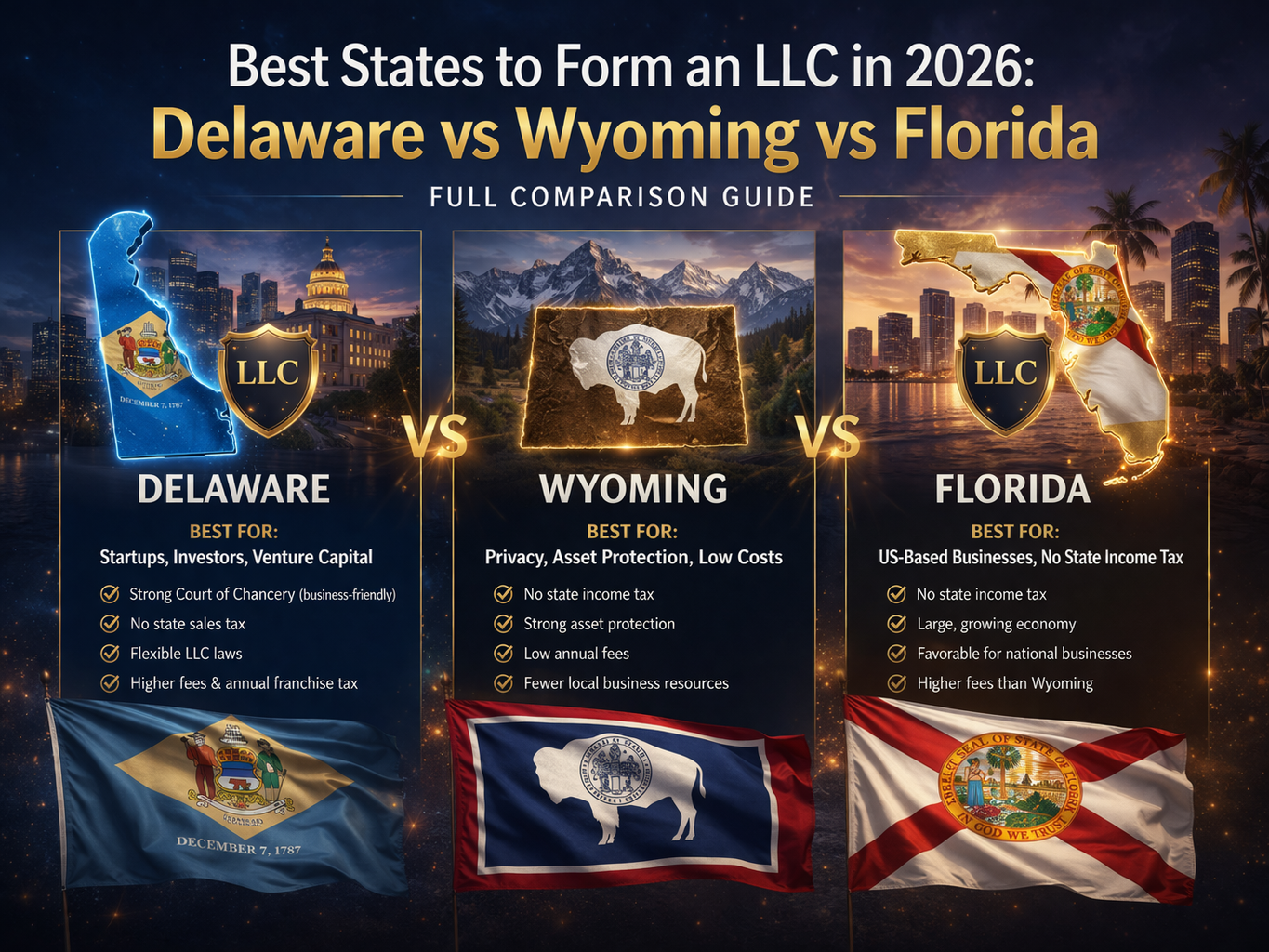
Best States to Form an LLC in 2026: Delaware vs Wyoming vs Florida (Full Comparison Guide)
Three States. One Decision. Zero Room for the Wrong Answer.
Most founders pick a formation state the way they pick a font for a pitch deck — quickly, based on what looks right, informed by something they read once and half-remember. Delaware because a podcast mentioned it. Wyoming because a Reddit thread ranked it first. Florida because that is where they live and it seemed simplest. The decision takes four minutes. The consequences run for the entire life of the company.
CORPIUS was built specifically because that gap — between the speed of the formation decision and the weight of its long-term implications — costs founders real money, real legal exposure, and real operational friction that compounds quietly in the background while they are busy building something. This article is not a ranking. It is not a fee table. It is not recycled content dressed in new subheadings. It is the formation state analysis CORPIUS runs before recommending a jurisdiction to any founder — the actual reasoning, the actual tradeoffs, and the actual questions that separate a formation decision from a formation strategy.
Stop Asking Which State Is Best. Start Asking Which State Is Best for What.
The formation industry has monetized vagueness. "Best state for LLC" is a search query that generates millions of results and almost none of them answer the actual question, because the actual question requires knowing something about the person asking it. The best state for a Ukrainian developer building a SaaS tool and accessing Stripe through a US entity is not the best state for a Miami-based construction company with twelve Florida employees. The best state for a New York attorney starting a solo practice is not the best state for a Silicon Valley startup raising a seed round from institutional funds. The answer changes with the business. The guides pretend it does not.
CORPIUS operates from a different premise: jurisdiction selection is an output of business analysis, not an input to it. The formation state is the last decision in a sequence, not the first. And the sequence begins with four questions that almost every formation guide skips entirely.
Does the business require institutional venture capital? Not "might eventually want" — requires, within a defined fundraising timeline. This question has a binary answer, and it produces a binary outcome in the state selection analysis.
Where does the business generate operational presence? Not where the founder wants to be registered — where employees work, where contracts are executed, where clients are physically served, where revenue is generated through activities that create regulatory nexus under state law. This question does not have a simple answer, and any guide that pretends otherwise is giving you a template rather than an analysis.
Does the ownership structure require privacy from public disclosure? For some founders this is a preference. For others — international entrepreneurs, high-profile individuals separating commercial and personal identity, multi-entity holding structures — it is a functional requirement. The answer changes which states are structurally compatible with the formation.
What is the realistic five-year compliance cost of maintaining this entity? Not the filing fee. The annual reports, the franchise taxes, the registered agent renewals, the foreign qualification fees in operating states, the amendment charges, and the compound effect of all of them across a planning horizon that extends beyond the excitement of launch.
The answers to those four questions map almost precisely onto the three states this article examines. What follows is what CORPIUS actually knows about each one.
Delaware: The Right Answer for a Specific Kind of Ambition
Delaware did not become the dominant institutional formation jurisdiction because it is the best state for most businesses. It became dominant because it is engineered for a specific category of business — the kind that raises money from professional investors, grows toward a liquidity event, and operates within legal documentation ecosystems that were built around Delaware's statutory framework and refined by its courts over a century of commercial litigation.
The Court of Chancery Is Not Marketing. It Is Infrastructure.
Delaware's Court of Chancery is a specialized equity court that handles nothing but business disputes. No jury. No generalist judges cycling between criminal cases and contract disputes. No legal uncertainty about how novel corporate governance questions will be analyzed. The Court of Chancery has been operating continuously since 1792 and has produced a volume and depth of commercial case law that no other US jurisdiction approaches. For businesses whose governance structures, investor rights, liquidation preferences, and equity arrangements will eventually be tested — either in litigation or in the due diligence process that precedes a transaction — that body of precedent is not theoretical value. It is the infrastructure that makes complex deal execution faster, cheaper, and more predictable.
When a venture fund's term sheet arrives, the governance documents attached to it — preferred stock terms, board observer rights, pro-rata participation provisions, drag-along mechanics — were drafted by attorneys who spent their careers in Delaware's legal ecosystem. The standard forms that institutional investors use are Delaware forms. Adapting them to Wyoming statutes or Texas governance law is not impossible, but it introduces friction at the precise moment when friction is most expensive: during a financing round where time is money and investor attention is finite.
Delaware's Privacy Advantage Is Real and Routinely Overlooked
Delaware LLCs are not required to disclose member or manager identity in any public filing. The Certificate of Formation contains only the entity name and the registered agent's information. Nothing else is publicly searchable. For a multi-investor LLC with a complex ownership structure, for a fund vehicle with limited partners whose identity is commercially sensitive, or for any founder who has a legitimate reason to keep personal name separate from commercial entity — Delaware provides genuine non-disclosure architecture that its formation marketing rarely emphasizes because the institutional investor audience it targets does not typically list privacy as a primary concern.
What Delaware Actually Costs When the Full Picture Is Visible
Delaware charges $90 at formation. The annual franchise tax for LLCs is $300, due June 1. Those numbers are accurate and entirely incomplete as a cost representation.
Every Delaware LLC that conducts business in another state — which describes essentially every operating company, because operating companies generate nexus where they operate — assumes that state's compliance obligations in full. A Delaware LLC with a San Francisco team pays California's $800 minimum franchise tax annually, California's gross receipts LLC fee above $250,000 in revenue, and California registered agent costs, in addition to Delaware's $300. A Delaware LLC signing contracts and employing staff in New York pays New York's compliance costs on top of Delaware's. The dual-jurisdiction structure is not an edge case in Delaware formation. It is the standard operational reality, and any formation cost analysis that presents only the Delaware side of that structure is presenting approximately half the relevant information.
The Honest Delaware Verdict
Delaware is the correct answer for founders raising institutional venture capital within 18 months, for entities built to be acquired or taken public within a defined horizon, and for companies whose legal ecosystem — investors, attorneys, counterparties — operates within Delaware governance assumptions. For every founder who does not fit that profile precisely, Delaware's institutional advantages are theoretical while its compliance costs are concrete and recurring.
Wyoming: The State That Was Engineered for the Founder the Industry Ignores
Wyoming passed the first LLC statute in the United States in 1977. Every other state's LLC framework descends from that original Wyoming statute. Wyoming did not stop at establishing the category — it spent the following five decades refining its LLC law toward the priorities of founder-operated businesses that institutional formation infrastructure systematically underserves: maximum asset protection, structural privacy, tax neutrality, and administrative simplicity at a cost that does not punish founders for building carefully rather than raising aggressively.
The result is a jurisdiction that CORPIUS recommends more frequently than any other for the founders it serves — not because Wyoming is the answer to every question, but because the founders CORPIUS serves most commonly ask the questions Wyoming answers better than any alternative.
The Charging Order: Wyoming's Most Underexplained Competitive Advantage
The charging order is the legal mechanism through which a judgment creditor attempts to collect from a debtor's LLC ownership interest. In most states, it is one available remedy among several — courts can, depending on circumstances, impose more aggressive collection against an LLC membership interest, including forcing dissolution or a sale of the interest to satisfy the judgment. Wyoming made a different statutory choice: the charging order is the exclusive remedy against an LLC membership interest. A creditor who wins a judgment against a Wyoming LLC member cannot force a sale of the membership interest, cannot vote the interest, cannot compel any distribution, and cannot take any action that would give them practical control over or economic benefit from the LLC's assets or operations beyond what the LLC itself chooses to distribute.
Wyoming extends this exclusivity to single-member LLCs — a distinction that matters enormously in practice. Most states that provide charging order protection at all allow courts to pierce the single-member structure on the grounds that no other members' interests would be harmed by more aggressive creditor remedies. Wyoming's legislature explicitly closed that gap. A single-member Wyoming LLC provides the same exclusive charging order protection as a multi-member one. For founders in industries where personal liability exposure is a structural reality — real estate investment, professional services, construction, financial intermediation, healthcare — that is not an incremental legal nuance. It is a fundamental difference in risk architecture.
Privacy That Cannot Be Dismantled by a Simple Database Search
Wyoming's non-disclosure of LLC membership is architecturally embedded in its statutory framework, not incidentally available through regulatory gaps. The Articles of Organization require the entity name and the registered agent's information. Member names are not filed. Manager names are not filed. Ownership percentages are not filed. Annual reports require only current registered agent information and the entity's principal address. The Wyoming Secretary of State's public database contains no ownership disclosure for the overwhelming majority of Wyoming LLCs, and that result is not an oversight — it is the intended output of a statutory system designed to attract privacy-sensitive entities for legitimate commercial and personal security reasons.
For international founders who have no interest in publishing personal identification in a US government database accessible to anyone with internet access, for business owners with public profiles who build commercial entities that should not be publicly searchable to their personal name, and for multi-entity holding structures where ownership chain visibility creates competitive or security exposure, Wyoming's privacy architecture is the only formation answer that is structurally compatible with the requirement.
The Five-Year Wyoming Cost in Actual Numbers
Formation: $100. Annual report minimum: $60 per year. Registered agent: $49–$150 per year at a mid-tier provider. State income tax on LLC earnings: zero. Personal income tax on member distributions: zero. Franchise tax beyond the annual report: zero.
Five-year total state cost for a Wyoming LLC operated remotely with no Wyoming-located assets: $400–$850 inclusive of all state obligations and registered agent service. No other commercially credible US jurisdiction provides equivalent legal infrastructure — exclusive charging order protection, statutory membership privacy, tax neutrality — at that cost level. The comparison is not marginal. It is categorical.
Where Wyoming Stops Being the Answer
Wyoming formation does not override the compliance obligations generated by business activity in states where activity occurs. This is the operational reality that transforms Wyoming from a universal solution into a precise one, and CORPIUS is deliberate about communicating it.
A Wyoming LLC employing a team member in Texas must register as a foreign entity in Texas and satisfy Texas compliance requirements annually. A Wyoming LLC operated by a founder conducting business from California — taking client calls, delivering services, signing contracts from a California address — may have California nexus that triggers California's foreign entity registration requirement and California's $800 minimum franchise tax, regardless of where the LLC was incorporated. Wyoming optimizes the home jurisdiction. It does not neutralize obligations generated by operational presence in other states.
Wyoming is the architecturally correct answer for international founders operating without US physical presence, for remote-first digital businesses with no geographic concentration of activity, for holding entities with no direct commercial operations, and for founders operating in states with reasonable compliance cost profiles. It is not the answer for founders whose business model requires operational presence in California, New York, or Massachusetts as primary markets — because those states' compliance costs apply regardless of formation jurisdiction, and paying Wyoming's formation cost plus California's operational compliance cost produces a dual-jurisdiction structure without the institutional advantages that make Delaware's dual-jurisdiction structure worth considering.
Florida: When Operational Logic Beats Jurisdictional Strategy
Florida does not belong in this comparison for the same reasons Delaware and Wyoming do. Florida is not a strategic formation jurisdiction in the sense that Delaware and Wyoming are — states selected precisely because their legal architecture provides advantages not available in the founder's operating state. Florida belongs in this comparison because it is frequently the correct answer for a specific founder profile that the other two states serve poorly: the founder whose business is a Florida business, built in Florida, operated in Florida, and serving a market that is substantially Florida.
That specificity is not a limitation. It is clarity. And clarity in formation state selection is worth more than any filing fee comparison.
What Florida's Commercial Ecosystem Actually Provides
Florida's LLC Act is a modernized, functional statutory framework adequate for the operational requirements of most small to mid-sized businesses. Florida's commercial courts have developed sufficient case law for standard business disputes. Miami's emergence as a genuine technology and international finance hub — with meaningful connectivity to Latin American capital markets, European founder communities, and the US institutional ecosystem — gives Florida entities commercial credibility with counterparties that purely administrative formation states cannot match. A Florida LLC presenting itself to a Miami-based client is a local entity. A Wyoming LLC presenting itself to the same client is an out-of-state entity that requires explanation.
For founders whose business operates within Florida's commercial geography, that credibility difference has operational value. It reduces friction in banking relationships, commercial leasing, client acquisition, and licensing processes where local entity status matters to counterparties who have no particular reason to be familiar with Wyoming's legal advantages.
Florida's absence of personal income tax benefits LLC members receiving pass-through income without requiring any cross-state structuring. For a founder living and conducting business in Florida, the tax structure is inherently favorable — no engineering required, no out-of-state registered agent relationship to maintain, no foreign qualification filing in the primary operating state, because the primary operating state and the formation state are the same jurisdiction.
Florida's Compliance Structure and the One Penalty That Catches Everyone
Florida charges $150 at formation. The annual report costs $138.75, due May 1. The late penalty is $400, applied automatically to every LLC that misses the deadline — not graduated, not warned in advance, not negotiable after the fact. May 2 produces a $400 invoice for every non-compliant Florida LLC simultaneously, without exception. That penalty structure is among the most aggressive applied to a routine annual compliance obligation in the US formation landscape, and it disproportionately affects exactly the type of founder who formed in Florida for operational simplicity and then discovered that simplicity requires active calendar management.
Florida's public disclosure requirements are meaningfully different from Wyoming's. Manager and authorized member names and addresses appear in annual report filings and are searchable through the Florida Division of Corporations database. For any founder whose formation includes membership privacy as a functional requirement, Florida's disclosure architecture is structurally incompatible with that requirement. Wyoming satisfies the privacy need. Florida does not, and no formation strategy can make it otherwise.
The Foreign Qualification Reality That Determines Florida's True Audience
A Wyoming LLC with a Miami team registers in Florida and pays Florida compliance costs annually in addition to Wyoming's. A Delaware LLC with Florida-based personnel registers in Florida and pays Florida compliance costs in addition to Delaware's. Florida formation is operationally efficient precisely when Florida is the sole or primary jurisdiction — when forming in Florida eliminates the foreign registration layer rather than adding a domestic layer on top of an out-of-state formation. Outside of that condition, Florida offers no structural advantage that justifies its cost profile over Wyoming's superior asset protection and privacy architecture.
The Florida formation answer belongs to the founder whose team, clients, contracts, and revenue are concentrated in the Florida market, who lives and operates in Florida, and for whom the operational simplicity of a single-state compliance structure — one annual report, one registered agent, one Secretary of State portal — is worth more than the cost efficiencies or legal architecture advantages available in other jurisdictions. That is a real and common founder profile. It is simply not universal, and treating it as universal is how founders in Florida end up forming in Delaware for reasons that have nothing to do with their business.
The CORPIUS Formation Framework: Five Decisions That Replace a Thousand Generic Recommendations
Formation state selection is not a question with a universal answer. It is a sequence of business-specific decisions that converge on a jurisdiction when the analysis is done correctly. CORPIUS runs this sequence for every founder before a filing is prepared.
Decision one: Institutional capital requirement. If a founding team is actively raising from institutional venture funds within 18 months and their investors' documentation infrastructure assumes Delaware governance, form in Delaware. The friction cost of being the non-Delaware entity in a Delaware-standard deal process exceeds the formation cost differential and the annual compliance premium. This decision is straightforward when the funding path is clear and meaningless when it is speculative.
Decision two: Primary operating state. If the primary operating state is California, New York, or Massachusetts — states with aggressive franchise tax structures, foreign entity registration requirements, and gross receipts-based levies — the formation state matters significantly less than the operating state compliance structure. Both Wyoming and Delaware will generate operating state obligations. Optimize the operating state compliance structure first; the formation state selection is secondary and should minimize home jurisdiction cost without introducing institutional friction.
Decision three: Privacy requirement. If ownership non-disclosure is a functional requirement — not a preference but an architectural necessity given the founder's profile, the ownership structure, or the commercial context — Wyoming is the only among the three states compared here that satisfies the requirement structurally. Florida discloses. Delaware discloses less but not comparably to Wyoming's complete non-disclosure. Wyoming is the answer when privacy is non-negotiable.
Decision four: Asset protection depth. If the business operates in an industry with elevated liability exposure and the founder's personal assets warrant maximum statutory protection, Wyoming's exclusive single-member charging order protection is the formation jurisdiction answer. Delaware's corporate law provides different protections calibrated to investor relationships rather than founder asset protection. Florida's asset protection framework is adequate but not exceptional.
Decision five: Operational geography. If the business is genuinely a Florida business — physically operated in Florida, serving Florida markets, employing Florida-based personnel — forming in Florida is operationally rational. If the business has no fixed operational geography or operates primarily in low-cost compliance states, Wyoming's cost structure and legal architecture represent the optimal home jurisdiction for the overwhelming majority of founder-operated businesses.
The Variable Every State Comparison Ignores: Where Your Business Will Be in Three Years
The formation state decision is made once. The business it creates grows, changes, adds team members in new states, establishes client relationships across jurisdictions, generates revenue through channels and geographies that did not exist at founding. Every new state where business activity creates regulatory nexus creates compliance obligations that the formation state cannot eliminate.
The founder who forms in Wyoming with a team of one and no US physical presence, then builds a business with employees in four states by year three, has four-state compliance obligations in year three regardless of the Wyoming filing. Wyoming remains the optimal home jurisdiction — lowest cost, strongest asset protection, best privacy architecture — while the four-state operational compliance structure is an independent consequence of business growth rather than formation strategy.
This is the variable that separates a formation decision from a formation plan: the honest projection of where business activity will generate nexus over the planning horizon, modeled alongside the home jurisdiction cost structure and evaluated against the institutional requirements of the funding path. CORPIUS does not sell formation filings. It builds formation strategies — the kind that account for where the business is going, not just where it is starting.
CORPIUS is not just a service — it is a complete AI-driven business operating system designed to handle everything from company formation and compliance to tax filing and operational automation. The formation state analysis in this article is not a product CORPIUS generates once and files away. It is an ongoing infrastructure decision that CORPIUS tracks through an intelligent platform that monitors compliance deadlines across every active jurisdiction, surfaces multi-state obligations before they generate penalties, and adapts the compliance structure as the business grows into new operational geographies. The state where your LLC lives is not a permanent sentence. It is a managed variable inside a system designed to keep your legal foundation aligned with your business reality — from the first filing to the last. Visit corpius.net and make the formation decision with the full picture in front of you, not the abbreviated version the industry prefers you to see.
Powered by AIR RISE INC & REVOLD AI — with Roman Kravchina and the CORPIUS team. 50 Central Park S #24A, New York, NY 10019 | +1 (347) 343-3353 | corpius.net
Share this post

Written by
Roman KravchinaCEO / CMO / CTO & Lead Architect & Senior Software Developer
Co-founder of AIR RISE INC & CORPIUS. Full-stack architect with expertise in scalable digital products, brand strategy, and technology leadership.
Related Posts

SBA Disaster Loans Remain Available in Multiple States: What Small Businesses Need Before They Apply | CORPIUS
4 min read

SBA's Manufacturing Finance Push Accelerates in 2026: How New Loan Tools Are Changing Growth Plans | CORPIUS
4 min read

SBA Working Capital Pilot Tops $150 Million: Why Small Manufacturers Are Turning to Flexible Credit | CORPIUS
4 min read
Ready to Form Your Business?
Our experts are here to guide you through every step.