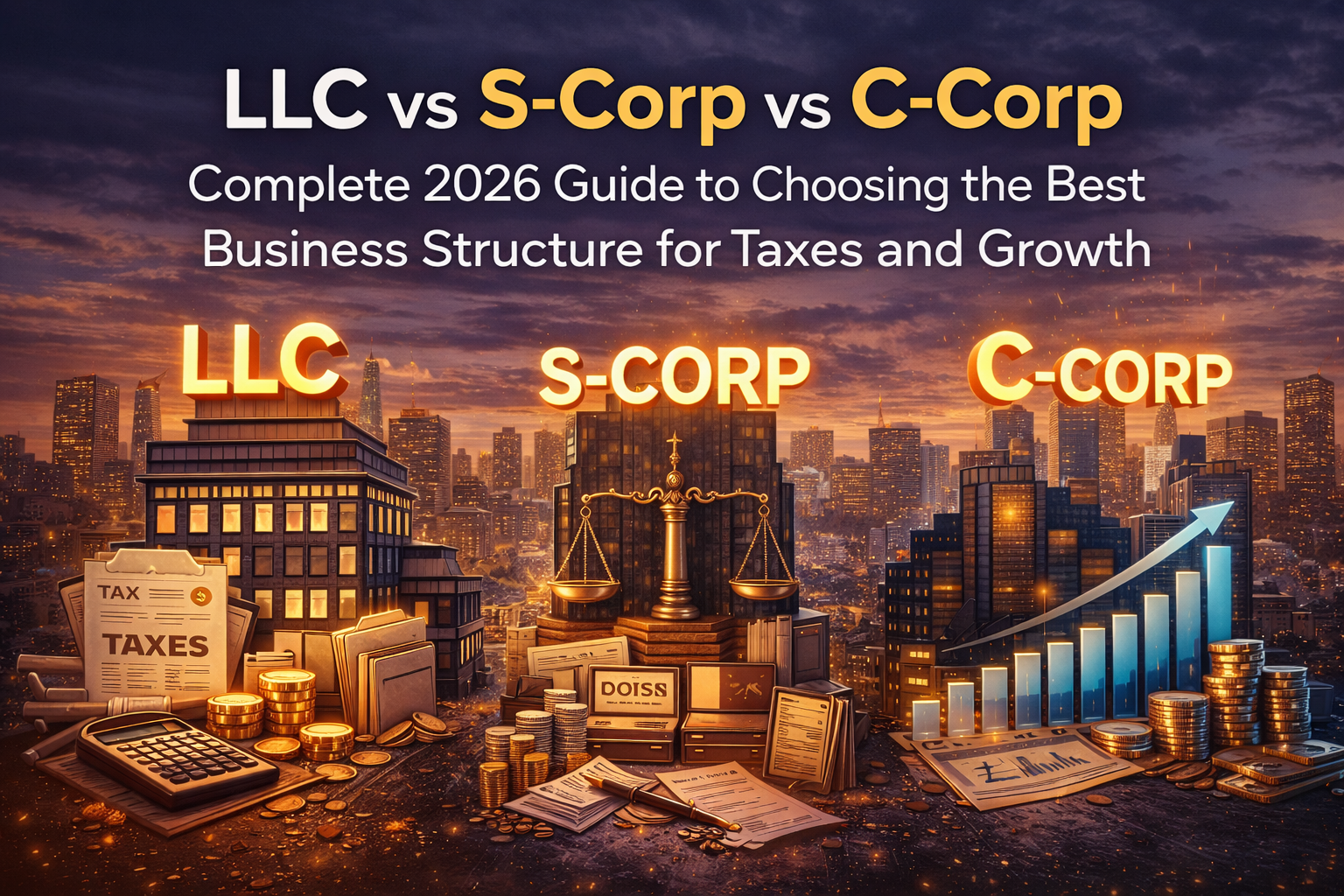
LLC vs S-Corp vs C-Corp: Complete 2026 Guide to Choosing the Best Business Structure for Taxes and Growth
LLC vs S-Corp vs C-Corp: Complete 2026 Guide to Choosing the Best Business Structure for Taxes and Growth
The decision most founders make in ten minutes will affect every dollar they earn for the next decade.
Business structure is not an administrative formality. It is the financial architecture of your company — determining how profits are taxed, how liability is distributed, who can invest, and how fast you can scale. And yet, the majority of entrepreneurs in the United States select their entity type by Googling "LLC vs Corporation" at midnight the day before their first client contract.
In 2026, with the IRS intensifying audit protocols for small businesses, multi-state compliance requirements expanding, and investor expectations evolving rapidly, the cost of getting this decision wrong has never been higher. This guide cuts through the noise and gives you a precise, decision-ready framework — whether you're a solo operator, a growing team, or a startup preparing for institutional capital.
Why Business Structure Matters More Than Ever in 2026
Three forces have made entity selection a mission-critical decision this year.
First, the tax environment has shifted. The Tax Cuts and Jobs Act provisions that benefited pass-through entities continue to sunset in phases, while corporate tax reform discussions have created new strategic windows for C-Corp structuring. The difference between an LLC taxed as a sole proprietorship versus an LLC with an S-Corp election can represent $15,000 to $40,000 in annual self-employment tax savings for founders earning above $80,000.
Second, capital is selective. Venture capital and institutional investors in 2026 require a Delaware C-Corporation as a near-universal prerequisite for funding. If you structure as an LLC and later seek institutional capital, the conversion process — while possible — creates friction, legal costs, and in some cases, taxable events that can reach six figures.
Third, compliance automation is redefining operational efficiency. Platforms like CORPIUS have eliminated the excuse that proper entity management is "too complex." The right structure, filed correctly and maintained with automated compliance tracking, is now accessible to any founder — not just those with a $500/hour attorney on retainer.
The Three Structures: What They Actually Are
Before comparing them, it's worth stripping away the jargon that makes this decision feel more complex than it is.
What Is an LLC?
A Limited Liability Company (LLC) is a flexible legal structure that separates your personal assets from your business liabilities. By default, it is a "disregarded entity" for tax purposes — meaning the IRS treats its income as your personal income, reported on Schedule C of your 1040.
However — and this is where most guides fail founders — an LLC is not a tax structure. It is a legal structure. The way your LLC is taxed is a separate election entirely. A single-member LLC can be taxed as a sole proprietorship, a partnership (multi-member), an S-Corporation, or a C-Corporation. This flexibility is the LLC's greatest strategic asset.
Best for: Freelancers, consultants, real estate investors, small service businesses, and international founders establishing a U.S. presence.
What Is an S-Corporation?
An S-Corporation is not a separate type of legal entity — it is a tax election made with the IRS (Form 2553) that can be applied to either a corporation or an LLC. When a business is taxed as an S-Corp, it becomes a pass-through entity: profits and losses flow through to shareholders' personal tax returns, avoiding corporate-level taxation.
The primary financial benefit: S-Corp shareholders who work in the business can split their income between salary (subject to payroll taxes) and distributions (not subject to self-employment tax). This split creates meaningful savings for profitable businesses — typically beginning to make mathematical sense around $50,000–$60,000 in annual net profit.
Best for: Established small businesses generating $50K–$500K in annual profit, service businesses, and operators who want to minimize self-employment taxes while maintaining pass-through taxation.
What Is a C-Corporation?
A C-Corporation is a fully independent legal entity, taxed at the corporate level (currently 21% federal rate). When profits are distributed to shareholders as dividends, those dividends are taxed again at the individual level — the so-called "double taxation" that critics cite. However, this framing misses the strategic picture entirely.
C-Corps retain earnings at the corporate level, often at a lower tax rate than individual rates for high earners. They can issue multiple classes of stock, have unlimited shareholders, and are the only structure that venture capital, angel investors, and most institutional funds will touch. Delaware C-Corps in particular have become the global standard for fundable startups due to Delaware's predictable corporate law and the Chancery Court system.
Best for: Startups seeking institutional funding, businesses planning to scale internationally, companies with complex equity structures, and any founder whose long-term exit strategy involves acquisition or IPO.
The Tax Comparison: Real Numbers, Not Theory
This is where most guides give you a table and call it analysis. We're going to go deeper.
Scenario 1: The Solo Consultant — $120,000 Annual Profit
| Structure | Taxable Treatment | Estimated Annual Tax Burden |
|---|---|---|
| Single-Member LLC (default) | Schedule C, SE tax applies | ~$35,000–$40,000 |
| LLC with S-Corp Election | Salary + Distribution split | ~$25,000–$29,000 |
| C-Corp | 21% corporate rate + salary | ~$27,000–$33,000 (depends on salary strategy) |
Winner: LLC with S-Corp election. Savings of $8,000–$12,000 annually versus default LLC — simply by filing Form 2553.
The catch: S-Corp status requires you to pay yourself a "reasonable salary" as defined by the IRS. Too low, and you risk audit. A licensed CPA or a compliance platform with built-in payroll benchmarks — like CORPIUS — is essential to execute this correctly.
Scenario 2: The Growth-Stage Startup — $500,000 Annual Profit, Seeking Investment
| Structure | Investor Compatibility | Tax Efficiency | Scalability |
|---|---|---|---|
| LLC | Low | High (pass-through) | Limited |
| S-Corp | Very Low (100 shareholder limit, no foreign shareholders) | High | Limited |
| C-Corp (Delaware) | Universal | Moderate (21% corporate rate) | Unlimited |
Winner: Delaware C-Corporation. The tax efficiency of pass-through structures becomes irrelevant when institutional capital is on the table. Investors don't just prefer C-Corps — they structurally require them.
Scenario 3: The International Founder Building a U.S. Presence
An entrepreneur based outside the United States seeking to access U.S. markets, open a U.S. bank account, and establish legal credibility with American clients faces a specific set of constraints. S-Corps are categorically unavailable to non-resident aliens. C-Corps and LLCs both work — but their operational requirements differ significantly.
Winner: Wyoming LLC or Delaware C-Corp, depending on capital strategy. Wyoming LLCs offer maximum privacy, minimal annual fees, and no state income tax. Delaware C-Corps offer investor compatibility and legal predictability.
CORPIUS handles both structures across all 50 states, including EIN acquisition for non-residents — one of the most friction-heavy steps in the process for international founders.
The Five Decisions That Determine Your Optimal Structure
1. Are You Seeking Institutional Investment?
If yes: Delaware C-Corporation. Non-negotiable. If no: Continue to question 2.
2. What Is Your Annual Net Profit?
- Under $40,000: Default LLC taxation is likely optimal. The administrative overhead of an S-Corp election (payroll, quarterly filings) may exceed the tax savings.
- $40,000–$500,000: LLC with S-Corp election is typically the highest-value structure. Run the numbers with a CPA.
- Above $500,000: C-Corp or S-Corp depending on reinvestment strategy. C-Corp becomes increasingly attractive as retained earnings accumulate at 21% versus individual rates up to 37%.
3. Do You Have or Plan to Have Foreign Shareholders or Investors?
S-Corps are prohibited from having non-U.S. shareholders. If international capital is in your future — even indirectly — eliminate S-Corp from consideration.
4. What Is Your Exit Strategy?
- Sale to a strategic acquirer or private equity: Structure matters. Many PE firms prefer asset purchases for tax reasons, which can disadvantage C-Corp sellers. LLC structures can simplify asset sales.
- IPO or VC-backed exit: C-Corp is the only viable path.
- Lifestyle business / hold indefinitely: Pass-through structures (LLC, S-Corp) maximize annual cash flow.
5. How Complex Is Your Equity and Compensation Structure?
If you have co-founders, plan to issue stock options, or need to create multiple share classes — C-Corp is the only structure that handles this natively. LLCs can issue "membership interest" and profit interest units, but the complexity and investor unfamiliarity creates friction at every fundraising round.
Common Mistakes That Cost Founders Thousands
Mistake 1: Defaulting to LLC because "everyone does it." An LLC is not inherently the best choice. It is simply the most flexible. Flexibility used without strategy is just noise.
Mistake 2: Waiting too long to make the S-Corp election. The IRS deadline for S-Corp election is March 15 for the current tax year, or within 75 days of entity formation for new businesses. Founders who miss this window lose an entire year of potential savings. CORPIUS tracks and automates compliance calendar deadlines to eliminate this risk.
Mistake 3: Forming in a "cheap" state without considering operational reality. Wyoming and Delaware are the optimal states for most businesses not requiring a physical presence. Forming in California because you live there subjects you to California's $800 minimum franchise tax, its aggressive Franchise Tax Board, and complex state-level S-Corp rules. Multi-state operations require a registered agent and compliance filings in every state where you have nexus — not just your formation state.
Mistake 4: Treating structure as permanent. Your optimal structure changes as your business grows. The LLC that made sense at $30,000 in revenue may cost you $40,000 in excess taxes at $300,000. Structure conversion is a legal and tax event that requires professional execution — but it is not exceptional. Plan for it.
Mistake 5: Separating entity selection from compliance and tax strategy. The entity type is one decision. The tax elections, annual filings, registered agent maintenance, operating agreements, EIN acquisition, and IRS compliance calendar are an ongoing operational system. Founders who treat these as separate tasks — managed across three different vendors — create gaps, miss deadlines, and accumulate penalty exposure.
This is precisely the operational problem CORPIUS was built to solve. Rather than managing your formation, your registered agent, your compliance calendar, and your tax filing preparation across multiple platforms, CORPIUS consolidates them into a single, AI-driven infrastructure layer — with automated alerts, document management, and filing support built in.
How CORPIUS Executes the Entire Process
Choosing the right structure is only the beginning. The execution — filing with your state, obtaining your EIN, drafting your operating agreement or bylaws, making your tax elections, and maintaining ongoing compliance — is where most founders lose time, money, and momentum.
CORPIUS handles this as a complete operational system:
- Business Formation: LLC, S-Corp, C-Corp, or Nonprofit — in any U.S. state — with state filing fees included and processing in 1–7 business days.
- EIN Acquisition: Employer Identification Number obtained without the weeks-long IRS manual process.
- Operating Agreements and Corporate Kits: Professionally prepared documents, not generic templates.
- Compliance Calendar: Automated tracking of annual reports, tax deadlines, and state filing requirements across every jurisdiction where your business operates.
- Tax Filing Support: Federal and state income tax preparation, including S-Corp elections, payroll taxes, and corporate returns (Form 1120, 1120S, 1065).
For international founders, CORPIUS provides end-to-end support from entity selection through EIN acquisition — including the specific documentation requirements that non-U.S. persons face when engaging with the IRS.
The platform operates across all 50 states. Pricing is fully transparent — no state filing fees added at checkout, no hidden charges on invoice.
The 2026 Decision Framework: A Summary
| Situation | Recommended Structure |
|---|---|
| Solo freelancer or consultant, under $40K profit | Single-Member LLC (default taxation) |
| Profitable small business, $50K–$500K profit | LLC with S-Corp election |
| Startup seeking VC or angel funding | Delaware C-Corporation |
| International founder, U.S. market entry | Wyoming LLC or Delaware C-Corp |
| Real estate investor | Single-Member or Multi-Member LLC |
| Nonprofit or mission-driven organization | Nonprofit Corporation (501(c)(3)) |
| Multi-founder startup, complex equity | Delaware C-Corporation |
No framework replaces a conversation with a licensed CPA or tax attorney about your specific situation. What this framework does is eliminate the uninformed choices that cost founders clarity, time, and capital before they ever speak to a professional.
Conclusion: Structure Is Strategy
The founders who build durable companies don't treat legal structure as a checkbox. They treat it as a foundational business decision — one that compounds in value or cost with every year of operation.
In 2026, the tools to get this decision right — and to execute it at the speed that modern business demands — are readily available. The gap between founders who act with precision and those who default to the most common option is no longer a gap in knowledge. It is a gap in execution infrastructure.
The right structure, executed correctly, maintained consistently, and connected to your compliance and tax systems — that is not overhead. That is operational architecture.
Corpius is not just a service — it is a complete AI-driven business operating system designed to handle everything from company formation and compliance to tax filing and operational automation. Whether you're forming your first LLC, making an S-Corp election, or registering a Delaware C-Corp for your next funding round, CORPIUS provides end-to-end execution with full transparency, no hidden fees, and AI-powered compliance infrastructure built for operators who move fast and build to last.
Powered by AIR RISE INC & REVOLD AI — with Roman Kravchina and the CORPIUS team.
Recommended Internal Links for This Post:
/services/llc— LLC Formation Services/services/c-corporation— C-Corp Formation/services/s-corporation— S-Corp Formation/services/income-tax-filing-planning— Tax Filing & Planning/knowledge-base/s-corp-vs-llc-tax-comparison— S-Corp vs LLC Knowledge Base Article
Word Count: ~2,600 words Primary Keyword: LLC vs S-Corp vs C-Corp Secondary Keywords: business structure 2026, LLC tax election, Delaware C-Corp, S-Corp election, business formation USA, EIN, compliance calendar
Share this post
Related Posts
How to Start an LLC in the USA in 2026: The Definitive Step-by-Step Guide for Entrepreneurs and Non-Residents
5 min read

Disruptive by Design: The Gatorade Effect and the Future of Innovation
5 min read

Women Founders Confront the Gender Funding Gap
5 min read
Ready to Form Your Business?
Our experts are here to guide you through every step.