How to Open a US Business Bank Account Without an SSN: Complete Guide for Non-Residents
They Built the American Banking System for Americans. Here Is How to Enter It Anyway.
The Social Security Number was created in 1936 to track retirement benefits. It was not designed as the primary identity credential for commercial banking. It was not designed as the gateway to payment infrastructure. It was not designed as the threshold condition for operating a legal business entity within the most commercially consequential financial system on earth. It became all of those things gradually, through decades of regulatory layering and institutional habit, until a nine-digit number issued by the Social Security Administration to US citizens and permanent residents became — functionally, if not legally — the credential that separates founders who can operate inside the American financial system from those who cannot.
That credential gap is not a law. It is not a federal requirement. It is an institutional default that the US banking system built for the population it was designed to serve and never adequately redesigned when that population became global. In 2026, the international founder forming a Wyoming LLC, acquiring an EIN, and preparing to open a US business bank account is not trying to circumvent a legal requirement. They are trying to navigate a system that was built without them in mind and has only recently, partially, and unevenly been updated to acknowledge that they exist.
CORPIUS has navigated this process for international founders across dozens of countries and every viable banking channel available in the current US environment. What follows is not a generic overview assembled from publicly available information. It is the operational intelligence built from doing this — the specific knowledge of what works, what has changed, what the conventional guidance gets wrong, and what the documentation precision requirement actually means for an application submitted by a founder 6,000 miles from the nearest US branch.
The American Financial System Has Split Into Two Parallel Worlds
Something structurally significant happened to US business banking between 2019 and 2024. The traditional banking sector — anchored by the major commercial institutions that have defined American financial infrastructure for a century — moved in one direction. A fintech banking layer moved in the opposite one.
The traditional sector tightened. FinCEN's enhanced beneficial ownership disclosure requirements, the implementation of the Corporate Transparency Act in January 2024, elevated KYC compliance mandates, and the internal compliance cost calculus that major banks apply to non-standard customer profiles have collectively made the traditional bank branch experience for non-resident founders more restrictive in 2026 than it was in 2019. The branch manager who once had discretionary authority to work through a non-standard documentation package now operates within compliance frameworks that leave less room for judgment and more room for rejection.
The fintech banking sector moved toward international founders deliberately. Mercury, Relay, Bluevine, and Wise Business did not accidentally discover that international founders needed banking access. They built for it. They identified a founder population that was growing rapidly — driven by the global expansion of US LLC formation as a commercial infrastructure tool — and that was being systematically underserved by the institution type that controlled the banking credential those founders needed. They built compliance workflows around the documents those founders actually possess. They built digital onboarding that does not require physical presence in any US geography. They built identity verification frameworks that treat a foreign passport and a properly prepared EIN as a complete verification package rather than an insufficient substitute for a Social Security Number.
The result is a banking landscape that is simultaneously more restrictive and more accessible than it was five years ago — more restrictive at traditional institutions where the compliance overhead of non-standard onboarding has made the calculus unfavorable, more accessible at fintech platforms where that same compliance complexity has been resolved into a documented digital workflow with consistent outcomes. Understanding which world you are entering, and why, determines whether the banking step in your US business setup takes four days or four weeks.
What the Rejection Letter Does Not Explain
Most international founders who have attempted to open a US business bank account at a traditional institution and received a rejection — or more commonly, an inconclusive response that functions as a rejection without explicitly being one — do not receive an explanation that is specific enough to be actionable. The rejection cites compliance requirements without identifying which specific requirement was unsatisfied. It references documentation insufficiency without specifying which document was missing or what would constitute a sufficient version of it.
This is not accidental opacity. It is the product of a compliance process that is designed to protect the institution rather than inform the applicant. The bank's compliance officer has identified a gap between the documentation provided and the verification standard required — but disclosing the specific gap creates legal and regulatory exposure for the institution if the applicant subsequently provides a document that bridges the gap and the bank denies the account on other grounds.
What CORPIUS has learned from working through this process repeatedly is that the rejection in the traditional banking context almost always traces to one of four specific conditions, none of which is disclosed in the rejection communication:
The in-person requirement. Most major US commercial banks have not eliminated the in-person branch appearance requirement for business account opening, regardless of what their websites suggest about digital onboarding. The digital onboarding flow exists for domestic sole proprietors and simple business structures where SSN-based identity verification can be completed remotely. For LLC accounts with non-resident beneficial owners, the compliance workflow escalates to a branch review that cannot be completed without physical presence. The website says apply online. The compliance team says come in person. The applicant is outside the United States. The application dies in the gap between those two realities.
The beneficial owner nationality flag. Bank compliance systems classify beneficial owners by nationality and residency status against internal risk matrices that are not published and not disclosed. A beneficial owner with a US address and a US SSN is classified at one risk level. A beneficial owner with a foreign address, a foreign passport, and no SSN is classified at a different risk level — one that, at many traditional institutions, triggers enhanced due diligence requirements that the institution has neither the workflow nor the willingness to complete for a standard business checking account.
The source of funds requirement. Traditional bank account opening for business entities frequently includes a source of funds inquiry — documentation or explanation of where the entity's initial capital comes from and what commercial activity will generate its ongoing revenue. For a non-resident founder forming a US LLC to access American payment infrastructure before generating US-based revenue, the honest answer to the source of funds question creates a compliance flag: the entity currently has no US revenue because the bank account it needs to receive US revenue is the account currently being applied for. The circularity is real, and traditional bank compliance systems are not structured to resolve it favorably.
The registered agent address classification. Wyoming LLCs — the predominant formation state for non-resident founders — list a registered agent address in Cheyenne, Buffalo, or another Wyoming city as the entity's registered address. Traditional bank systems sometimes classify registered agent addresses as commercial mail-receiving locations rather than genuine business addresses, triggering additional documentation requirements for commercial activity at that address. The registered agent address is legally valid. The bank compliance system does not always recognize that validity without escalation.
None of these conditions appear in the rejection letter. All of them are navigable — but only by routing around the traditional banking path entirely and toward the fintech platforms whose compliance infrastructure was designed without those specific failure points.
Mercury: Not a Workaround. An Architecture.
The framing of Mercury as a workaround for founders who cannot access traditional banking is analytically incorrect and does Mercury a disservice that obscures why it works. Mercury is not a temporary bridge to a better banking relationship. It is a banking architecture built for the operational requirements of founder-operated businesses — which happen to include the non-resident founder population as a constituent group it serves comprehensively.
Mercury's accounts are FDIC-insured through its banking partners. They carry US routing and account numbers that are indistinguishable from any other US business bank account in their function within the American payment system. They support domestic and international wire transfers, ACH payments, debit card transactions, and API integrations with accounting software. Stripe, PayPal Business, Shopify Payments, and every major US payment platform accepts a Mercury account number as a valid US business bank account. The banking credential that Mercury provides is not a second-tier alternative. It is the functional equivalent of what a Chase business account provides for US-born founders — without the documentation requirements that Chase applies to non-resident owners.
Mercury's non-resident onboarding requires four documents, no more: the entity's EIN confirmation, the Articles of Organization from the state of registration, a compliant Operating Agreement, and a valid government-issued passport for the beneficial owner. The application is completed digitally. There is no branch to visit, no banker to schedule a meeting with, and no in-person appearance requirement at any point in the process.
What Mercury does require — with more precision than the onboarding documentation makes obvious — is that those four documents form a completely consistent package. The entity name that appears on the EIN confirmation must appear in identical form on the Articles of Organization. The entity name on the Articles of Organization must appear in identical form in the Operating Agreement. The beneficial owner's name in the Operating Agreement must match the beneficial owner's name on the submitted passport — full legal name, exact spelling, no abbreviations or informal variants. The registered agent information in the Operating Agreement must be consistent with the registered agent information in the state formation documents.
Mercury's compliance review is largely automated at the document comparison stage. Automated comparison means that a comma that appears in the Articles of Organization and is absent in the Operating Agreement is a discrepancy the system flags — not a human reviewer who might exercise judgment about whether it matters. The flag generates a compliance hold. The compliance hold generates a documentation correction request. The correction request adds five to ten business days to the timeline. The entire sequence is avoidable if the four documents are verified for consistency before the application is submitted rather than after the hold is issued.
CORPIUS prepares formation documents with banking onboarding as a co-equal objective alongside legal compliance. The Operating Agreement is not prepared to satisfy formation requirements and then handed to the founder with a note to use it for banking. It is prepared with Mercury's — and every other fintech platform's — consistency requirements built into the drafting process. That distinction eliminates the most common source of delay in the non-resident account activation sequence.
Relay, Wise Business, and Bluevine: Three Tools for Three Operational Problems
Mercury solves the primary US business banking credential problem. The three platforms alongside it in the non-resident banking ecosystem solve different operational problems that Mercury's architecture does not address with the same depth.
Relay solves the internal financial organization problem. A non-resident founder running a digital product business with meaningful revenue needs to organize that revenue across categories — operating expenses, quarterly tax reserves, owner distributions, emergency capital — from the first operating month. Doing this within a single bank account requires manual accounting discipline that most founders apply inconsistently under operational pressure. Relay's sub-account architecture allows multiple designated accounts within a single business banking relationship, each with its own balance and transaction history, all visible within a single dashboard. The tax reserve account is not a spreadsheet cell — it is a separate account that receives a designated percentage of each deposit automatically, sits untouched between quarters, and is available in full when the quarterly estimated tax payment is due. The operational discipline that most founders intend to apply but do not consistently maintain becomes a banking infrastructure feature rather than a personal finance habit.
Relay's documentation requirements and non-resident accessibility parallel Mercury's precisely. It is not a lesser option — it is a differently optimized one, more valuable for founders who arrive with a clear vision of how they intend to manage cash flow within the entity than for founders who need a clean, simple primary account and will build operational sophistication over time.
Wise Business solves the cross-currency problem that domestic fintech accounts were not built to address. A non-resident founder whose personal financial life exists outside the United States — whose rent, family expenses, personal savings, and lifestyle costs are denominated in a currency other than USD — needs to convert a portion of US business revenue to non-USD currency regularly. Doing this through a Mercury wire transfer and a personal currency exchange service is possible. It generates exchange rate costs and transaction fees that compound across monthly transfers over the life of the business.
Wise Business holds USD, EUR, GBP, and dozens of other currencies simultaneously within a single business account. It converts between them at mid-market exchange rates with a transparent conversion fee rather than the opaque spread that traditional international wire services apply. For a non-resident founder distributing personal earnings from a US business to a personal account in Poland, Brazil, Ukraine, or any of the other countries where CORPIUS serves the international founder community, Wise Business in the architecture alongside Mercury is not a convenience — it is a meaningful annual cost reduction that compounds with business growth.
Bluevine solves the US credit access problem. A non-resident founder cannot build a US personal credit score. A non-resident founder does not have a US credit history. The credit access that US-born business owners build through decades of personal financial activity — credit cards, auto loans, mortgages, revolving credit lines — does not exist for the international founder entering the US financial system through a newly formed LLC. Bluevine's credit line underwriting is based on business account performance, not personal credit history. Revenue consistency, account standing, and entity financial behavior over time are the inputs to Bluevine's credit model — all of which a non-resident founder can build through normal business activity in a way that SSN-based personal credit cannot be built without a Social Security Number.
The Bluevine credit line is not available on day one. It develops as the business demonstrates consistent performance over months. That timeline is not a limitation — it is the correct sequencing. A business that has operated for six months, processed consistent revenue through its Bluevine account, and maintained clean account standing is a materially lower credit risk than a newly formed entity with no financial history. Bluevine's architecture recognizes that distinction and rewards it with credit access that the personal credit gap would otherwise prevent entirely.
The Corporate Transparency Act: The Compliance Dimension Nobody Explained Correctly
When the Corporate Transparency Act took effect on January 1, 2024, the coverage it received in founder communities focused almost exclusively on the compliance obligation it created: most newly formed US LLCs must report beneficial ownership information to FinCEN within 30 days of formation. The penalties for willful non-compliance — civil penalties up to $591 per day and criminal penalties for intentional violations — received appropriate emphasis.
What received insufficient emphasis is what the CTA does for non-resident founders in the banking context.
Before the CTA, a non-resident-owned Wyoming LLC was, from a federal registry perspective, an entity whose ownership the US government had no centralized mechanism to verify. State formation documents disclosed no membership. IRS EIN records identified the entity but not necessarily the beneficial owner with specificity. FinCEN's customer due diligence rules required banks to collect beneficial ownership information, but the information existed only within individual banks' records — there was no federal database against which bank compliance teams could cross-reference what they had been told.
The CTA changed that architecture. The Beneficial Ownership Information database maintained by FinCEN now contains a government-verified record of who owns and controls most US LLCs. Financial institutions have access to this database for compliance verification purposes. A non-resident founder who files an accurate, timely BOI report with FinCEN has created a government-maintained ownership record that banking compliance teams can reference when reviewing the account application.
The practical consequence: a timely, accurate CTA filing reduces the documentary burden the bank must independently satisfy during onboarding. It does not replace the documentation package — Articles of Organization, Operating Agreement, EIN confirmation, and passport still form the complete credential stack. But it adds a corroborating government record to that package that reduces the probability of a manual compliance escalation. For non-resident founders whose application might otherwise trigger enhanced due diligence based on beneficial owner nationality alone, a filed CTA report is the difference between automated processing and a manual review queue.
Filing is straightforward: the FinCEN beneficial ownership reporting portal accepts applications digitally, requires the entity's EIN and formation information alongside the beneficial owner's full legal name, date of birth, home country address, and government-issued identification document. For international founders, the government-issued ID is typically the passport submitted to the banking platform. Using the same document for the CTA filing and the banking onboarding ensures that the name and identification number in the FinCEN record matches what the bank receives — another consistency layer that reduces rather than introduces compliance friction.
The Exact Document Sequence CORPIUS Builds for Every International Founder
The path from no US entity to an active, fully functional US business bank account is not complicated when every step is executed in the correct order with the correct documentation. It becomes complicated when steps are taken out of sequence, documents are prepared independently without consistency verification, or banking applications are submitted with documentation that has not been reviewed as a unified package.
CORPIUS builds this sequence as an integrated infrastructure process, not a series of disconnected administrative tasks. What follows is the sequence as we build it — not as a checklist to be handed to a founder and completed independently, but as a description of what correct execution looks like from the first decision to the first banking transaction.
Formation begins with state selection calibrated to the specific founder profile. For the overwhelming majority of non-resident founders with no fixed US operational presence, Wyoming is the correct answer: zero membership disclosure, zero state income tax, strongest available single-member asset protection, and $100 at formation with $60 annually in state fees. The Articles of Organization are filed digitally. The entity name is determined at this step — and the name chosen here becomes the name that appears, identically, on every document that follows.
The Operating Agreement is prepared with banking onboarding as an explicit design criterion alongside legal governance. The beneficial owner is identified by full passport name — not nickname, not abbreviated middle name, not any name variant that differs by a single character from what appears on the travel document that will be submitted to Mercury, Relay, or Bluevine. Ownership percentage is stated with specificity. Managing authority is designated explicitly. The entity name in the Operating Agreement header, the signature block, and every internal reference matches the Articles of Organization character for character.
EIN acquisition is completed through the IRS international applicant telephone line at (267) 941-1099, available Monday through Friday between 6:00 AM and 11:00 PM Eastern Time. Form SS-4 is prepared completely before the call begins — not during it. The IRS representative issues the EIN during the call. The EIN confirmation is documented immediately and added to the credential stack. For founders who cannot accommodate the telephone channel, IRS Form SS-4 is submitted by fax to (304) 707-9471 for processing within four business days.
The CTA beneficial ownership report is filed with FinCEN within 30 days of the formation date. The beneficial owner information in the report uses the same passport document submitted to the banking platform — identical name, identical document number, identical home country address.
The banking application is assembled only after all four documents exist and have been reviewed as a unified package for cross-document consistency. Every instance of the entity name across all documents is confirmed identical. The beneficial owner's name in the Operating Agreement is confirmed identical to the passport. The application is submitted to Mercury as the primary banking platform, with Wise Business onboarding initiated simultaneously if the cross-currency operational requirement exists.
Account activation at Mercury under this sequence takes two to five business days under standard processing conditions. By day five from application submission, the non-resident founder has an active US business bank account, a US routing number, a US account number, and the banking credential that makes the LLC commercially functional within the American financial system.
CORPIUS is not just a service — it is a complete AI-driven business operating system designed to handle everything from company formation and compliance to tax filing and operational automation. The international founder who arrives at CORPIUS needing a US business bank account without a Social Security Number leaves with more than an account number. They leave with a complete US business infrastructure — the right formation state for their specific profile, an EIN acquired through the correct channel, an Operating Agreement drafted for banking compliance and not just legal sufficiency, a CTA filing that positions the entity correctly in the federal beneficial ownership registry, and a banking relationship activated through a platform whose architecture was built for exactly this founder — managed through a single intelligent system powered by REVOLD AI that tracks every obligation, every deadline, and every compliance requirement automatically as the business grows. The US financial system was not built for you. CORPIUS was. Visit corpius.net and build your US business infrastructure today.
Powered by AIR RISE INC & REVOLD AI — with Roman Kravchina and the CORPIUS team. 50 Central Park S #24A, New York, NY 10019 | +1 (347) 343-3353 | corpius.net
Share this post
Related Posts

Do You Need an LLC for Your Online Business? Shopify, Amazon, and Freelancers Explained
5 min read
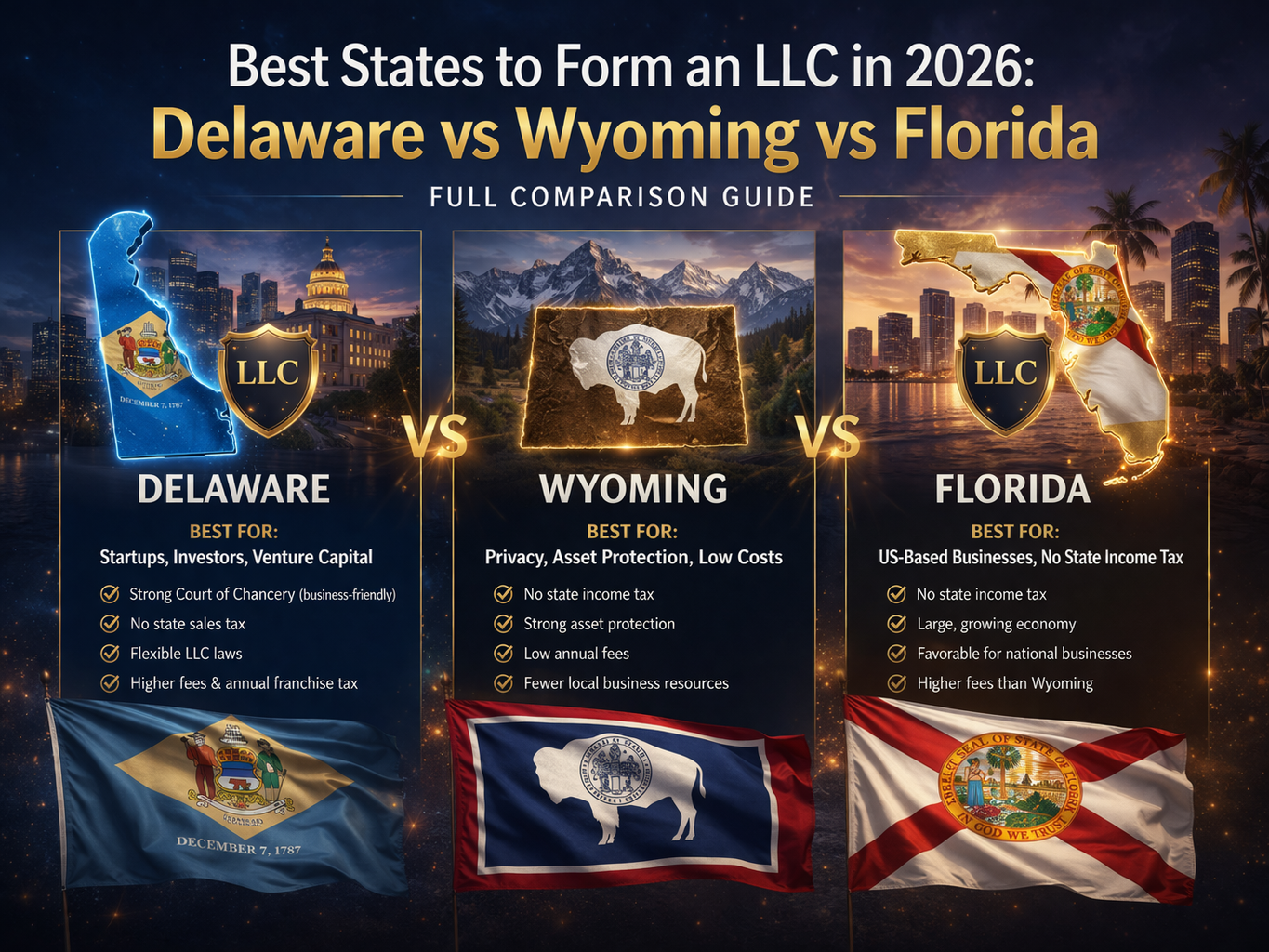
Best States to Form an LLC in 2026: Delaware vs Wyoming vs Florida (Full Comparison Guide)
5 min read

How Much Does It Cost to Start an LLC in the US? Full 2026 Breakdown with Hidden Fees Explained
5 min read
Ready to Form Your Business?
Our experts are here to guide you through every step.